

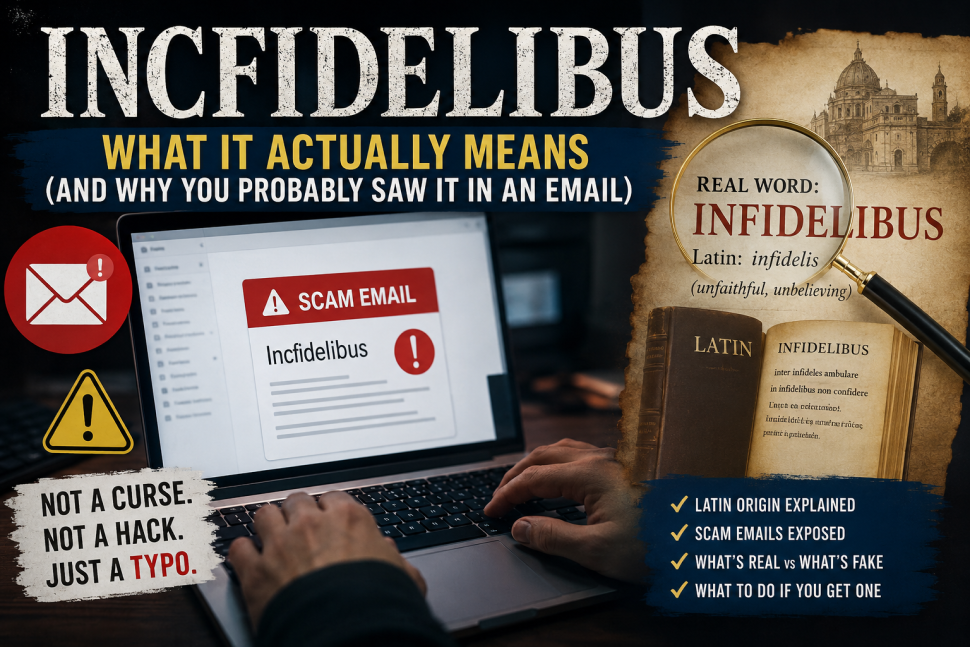
Okay so you Googled “Incfidelibus” and you’re a little freaked out. I get it. Let me say this first: nothing scary is going on. Incfidelibus is a spelling mistake, nothing more, no curse, no hacked device, no secret code buried in it. Stick with me and you’ll know exactly why you saw it.
Short version: it’s a typo. Real word underneath is infidelibus, Latin, dative or ablative plural of infidelis, which just means “unfaithful” or “unbelieving.” That extra c has no business being there, grammar-wise. But the Latin lesson isn’t really the point. The point is this misspelling keeps popping up in scam emails, and that’s probably why you clicked on this page in the first place.
Before writing any of this I went through what’s floating around online about the word, sorted what actually traces to a real source from what’s just guesswork dressed up as fact. Below is both the grammar and the scam-email side of it. The second part matters more, if I’m honest.
Quick Version
Incfidelibus is a typo of infidelibus, a real Latin word made from infidelis (unfaithful) plus a standard plural ending. You’ll run into it in two places. One, old digitized Latin texts. Two, far more likely given why you’re here, a scam email dressed up to sound official. The word on its own can’t do anything to you. Nobody’s turned up proof of a real company, app, or brand tied to the name Incfidelibus.
Incfidelibus Meaning: Breaking Down the Latin
Take away that extra c and you get infidelibus, and that part checks out completely, nothing shaky about it once you look at the pieces.
Start with fidelis. Faithful, loyal, trustworthy, from fides, meaning faith. Cicero used this word all the time, and you’ll find it scattered through Roman legal and military writing whenever someone needed a word for “can be trusted.” Add the prefix in-, which just negates things in Latin the way “un-” does in English, and you land on infidelis: unfaithful, disloyal, unbelieving. Tack -ibus onto the end, a completely ordinary plural ending for this kind of Latin adjective, and you get infidelibus, roughly “to the unbelievers” or “among the unbelievers” depending what surrounds it in a sentence.
In Christian Latin this word picked up extra religious meaning over time. Infideles came to mean people outside the faith, and you’ll find phrases like inter infideles or in infidelibus running through medieval theology, Thomas Aquinas used it, it shows up in canon law too.
That c, though? No rule puts it there. It just doesn’t belong, plain and simple. Best guess is somebody mistyped it once, maybe transcribing an old manuscript by hand, maybe an OCR scanner misread a letter on some digitized page, and the mistake got copied around enough times that it started looking like its own word.
Why Incfidelibus Won’t Stop Showing Up Online
A couple of things got mixed together here, and separating them out helps.
The typo itself probably started small and boring, somewhere in a scanned document or an old transcription. Once a misspelling like that exists online, though, search engines don’t know it’s a mistake, they just treat it as a word people are searching, and that pulls in articles trying to explain it, which pulls in more searches. It feeds itself.
Then there’s the reason you’re probably actually here. Incfidelibus has been turning up in emails that claim to have hacked your webcam, stolen your files, or gotten into your accounts. Scammers use a strange word like this because it sounds official, more threatening. If Incfidelibus showed up as a sender name or in a scary subject line, that’s almost certainly what you’re dealing with. These emails go out to thousands of people at once, automatically. Nobody actually broke into your device. It’s fear. That’s the whole mechanism.
There’s also a smaller thread where the Incfidelibus name pops up near ads for phone-monitoring or spy apps. Whether that’s connected to the scam emails or just the same word getting reused, I honestly can’t say for sure. Either way, be careful around that whole category. Spying on someone’s phone without them knowing is illegal in most places. The services that advertise doing it are usually scams themselves, just after your card number.
Incfidelibus: What’s Real and What’s Just Made Up

People claim a lot about this word. Most of it falls apart under any scrutiny at all.
What actually checks out: it’s a typo of the genuine word infidelibus, that word really does appear in medieval texts including Aquinas’s writing, and the grammar behind it is completely standard, nothing unusual there at all. Its connection to scam emails is reported pretty consistently and matches known scam patterns, even without one single definitive source. Same with the phone-monitoring angle, reported, but murky, nobody’s nailed down an actual company behind it.
What doesn’t check out, at all: any claim that this word has deep historical meaning on its own, that it’s some kind of recognized brand for gaming or usernames, or that it’s tied to a lost painting, a dining concept, whatever. None of that points back to a real source. No text, no name, no date. It reads exactly like content written to fill a page around a word that had traffic and nothing solid behind it, because that’s probably exactly what happened.
Got an Incfidelibus Email? Here’s What To Do
If it’s threatening you about your webcam, your files, claims your device is compromised: that’s spam. Don’t write back. Don’t click anything in it. Definitely don’t send money, especially not crypto. Report it as phishing so your inbox learns to catch the next one automatically. And if it’d make you feel better, go ahead and change your email password and turn on two-factor, not because the email actually proved anything, just because it’s a good habit anyway.
If instead it’s pitching you some phone-monitoring service directly, treat it like you’d treat anyone promising to get you into someone else’s phone without them knowing. It won’t work the way they say. It’s probably illegal to use. And they mostly just want your card details.
The General Pattern Behind These Emails
Not a one-off scam, by the way, this one. It’s one version of something that’s been going around for years, people call it sextortion email or hacker extortion spam, and knowing the shape of it helps no matter what weird word shows up next time.
Usually there’s a claim about your device being compromised somehow, webcam, browsing history, some malware supposedly sitting there for months. A lot of the time they’ll throw in an old real password of yours, pulled from some breach that has nothing to do with your current accounts, just to make it feel more believable. Payment’s almost always demanded in crypto because it’s harder to trace back. And there’s a countdown, usually a day or three, built specifically to rush you into paying before you stop and think about it.
None of that is proof of anything. It’s a pressure tactic. If you do spot an old password of yours in one of these, sure, go update it somewhere, can’t hurt, but it doesn’t mean anyone’s actually watching you right now. The FTC has a consumer alert on exactly this kind of bitcoin blackmail email, worth a look if you ever get one of these.
Incfidelibus FAQs: A Few More Things People Ask
What does Incfidelibus actually mean?
It’s a typo. The real word sitting underneath is infidelibus, and in Latin that’s roughly “to the unbelievers.” By itself, Incfidelibus isn’t a word. Never was.
Why did it show up in your inbox specifically?
Because a spam operation grabbed a strange-sounding word and mass-mailed it to thousands of people, you included, hoping the unfamiliar Latin would spook someone into paying. Nothing more personal than that going on.
Is there an actual company behind the name?
Not one anyone’s managed to verify, no. It does keep turning up near ads for phone-monitoring apps, which is reason enough to steer clear of anything using the name commercially.
Is it even real Latin, technically?
Sort of, minus the extra letter. Peel off that c and infidelibus is completely legitimate, documented, unremarkable Latin grammar. The c is just where the mistake lives.
Does the email itself mean something?
It doesn’t, not because of this particular word anyway. Treat it exactly how you’d treat any other piece of scam mail landing in your inbox, ignore it, don’t hand over money, hit report.
Is there any risk just from Googling the word or reading about it here?
None. Searching a word has never put anyone in danger. The actual risk only shows up the moment someone clicks a bad link or wires money because a scary email told them to.
Incfidelibus: Bottom Line
Incfidelibus is a typo, honestly, that’s the whole story. Real word underneath it, real grammar, nothing spooky. It picked up attention because scam emails and sketchy phone-monitoring ads latched onto it. Not because it means anything on its own. Got Incfidelibus in a scary email? Ignore it, it’s spam. Looking into phone security generally? Stay skeptical of anything promising to hack or monitor a device, no matter what word gets slapped on it this time.
If you’re generally trying to sort real platforms from content-farm noise online, our breakdown of Sosoactive walks through a similar pattern, separate word, same kind of messy search results.
[…] the extra “c” and you’re left with infidelibus. Real word. Documented. Not controversial in the slightest, once you break it into its […]