

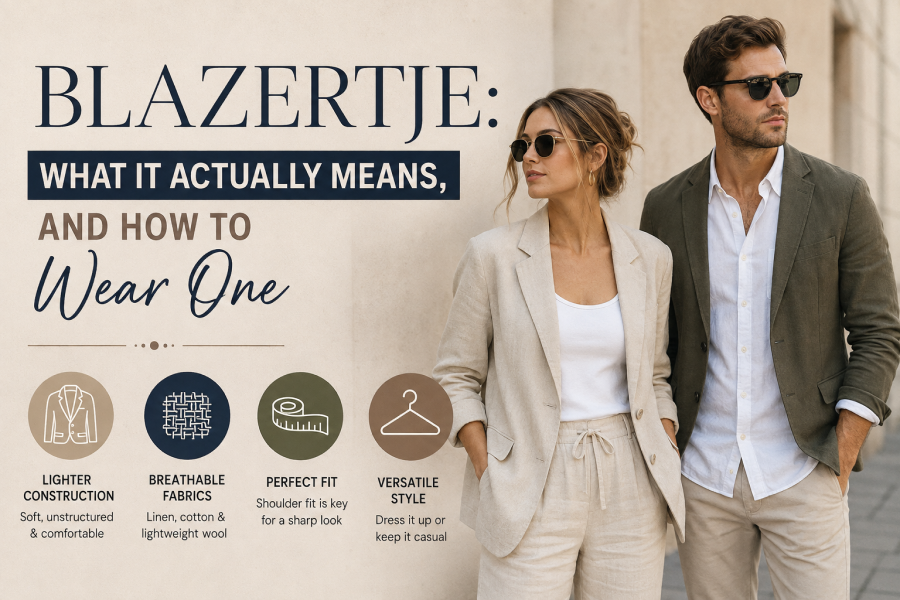
Blazertje is Dutch, little blazer, literally, built from “blazer” plus the diminutive ending “-tje.” Less a smaller jacket than a genuinely different construction. Lighter fabric. Softer shoulders. Barely any padding. More relaxed through the body than a regular blazer, yet it keeps that tailored shape separating a blazer from just a soft jacket with lapels sewn on. That distinction is exactly why it’s worth understanding before buying one.
Covering the actual word origin here, what separates it from a normal blazer in construction terms, which fabrics hold up over time, how it fits across different builds, and how people genuinely wear it day to day. Not repeating the same paragraph twice, which is apparently how half the sites ranking for this term decided to pad their word count.
Where the Word Blazertje Actually Comes From
Dutch tacks endings onto nouns to make them sound smaller or more casual. Usually -je. Sometimes -tje, -pje, -kje, or -etje, depending on how the base word sounds. Same pattern turns “huis” into “huisje,” house into little house, nothing unusual about the grammar here. Cambridge’s Dutch dictionary lists blazer as the standard jacket. Add -tje, you get blazertje.
Physically smaller isn’t really the point, interestingly enough. People reach for the word to describe a blazer that just feels different, softer, more relaxed, whether or not it’s actually shorter than a standard one. No official spec sheet exists for any of this. Closer to a vibe than a strict garment category, and brands genuinely interpret it a little differently from each other, which explains some of the inconsistency you’ll find shopping around.
Blazertje vs. Blazer: What Actually Changes in the Construction
A regular blazer usually has canvas sewn inside it. A stiffer layer between the shell fabric and lining, giving the jacket its shape and letting it hold that shape even sitting empty on a hanger. Padded shoulders come standard too, fabric runs heavy, 300 to 400 grams per square meter in most wool suiting, sometimes climbing higher.
Strip most of that away and you land on a blazertje. Unstructured, quarter-canvas at best, often unlined completely. Shoulders get little to no padding. The jacket just drapes based on the body underneath rather than holding a shape on its own. Fabric drops to somewhere around 200 to 280 grams per square meter, noticeably lighter, and that weight difference changes how it packs, moves, even how it sits on a hanger. Lapels run narrower, frequently unpressed. Length skews shorter, cropped in a lot of cases, though that particular detail isn’t consistent across every brand making them.
Blazertje Fabric That Actually Holds Up
Linen’s the obvious pick for warm weather, breathable, textured, meant to look slightly rumpled anyway, so lighter construction actually works with it instead of fighting it. Need a bit more structure without sacrificing breathability? Cotton twill splits that difference nicely for most of the year. Then there’s wool, tropical weight specifically, sometimes blended with linen, holding shape better than either fabric alone while still staying light enough to count as blazertje weight rather than tipping into full suiting territory.
Viscose sits at the budget end. Constant in cheaper pieces, decent drape, a bit of shine to it. Sags and loses shape faster than natural fiber, though, once you’ve actually worn it enough times to matter.
Getting a Blazertje’s Fit Right
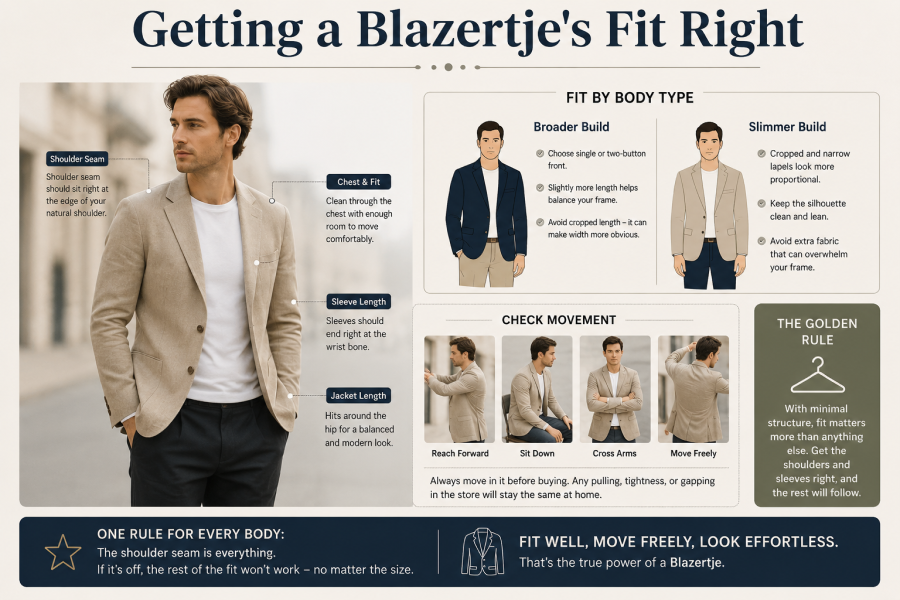
Start with the shoulder seam, honestly, it matters more than anything else here. Needs to land right at the edge of the natural shoulder, no padding exists to fake a fit the way a structured blazer gets away with. Broader through the shoulders or chest, a single or two-button front with slightly more length balances things out better than going cropped (cropped can actually make width more obvious, not less). Slimmer builds work the opposite way, cropped and narrow-lapeled reads more proportionate there instead.
Sleeves stop right at the wrist bone. And because these run unstructured so often, checking whether the sleeve bunches or rides up when the arm bends actually matters more here than it would on a fully canvassed jacket.
One thing holds true no matter the build though. Move in it before buying it. Reach forward, sit down, cross your arms, whatever it pulls or gaps on in the store is exactly what it’ll keep doing once it’s home in the closet.
How People Actually Wear These Day to Day
For women, a t-shirt and jeans underneath keeps things casual but pulled together. A slip dress underneath dresses it up without tipping fully formal. A fitted top works fine for most business-casual offices too. Men tend to pair it with chinos or well-fitted jeans, something plain layered under it, a t-shirt or button-down usually, keeps the whole thing from reading costumey.
Buttoning it all the way up over dress trousers pushes it toward looking overly formal for what it’s actually built to do. Leaning casual is really where it works best either way. Trying to sub it in as a suit jacket for something genuinely formal usually doesn’t land well, the construction was simply never built to carry that kind of weight.
Blazertje Pricing: What the Price Tag Is Actually Buying
Below $80, expect polyester or viscose blends, glued or fused construction instead of sewn canvas. Fine short-term. Doesn’t hold up over years of wear. Between $80 and $200, cotton and linen start showing up more consistently, along with wool blends, better stitching, sometimes real half-canvas construction underneath.
Past $200, natural fiber only becomes the norm, better hardware, construction that genuinely keeps its shape through repeated wear rather than falling apart after a handful of outings. Most of what’s actually being paid for at that price point is fabric and construction quality, not the name on the label. Worth checking the composition tag before assuming a higher price automatically means better made.
Actually Taking Care of a Blazertje
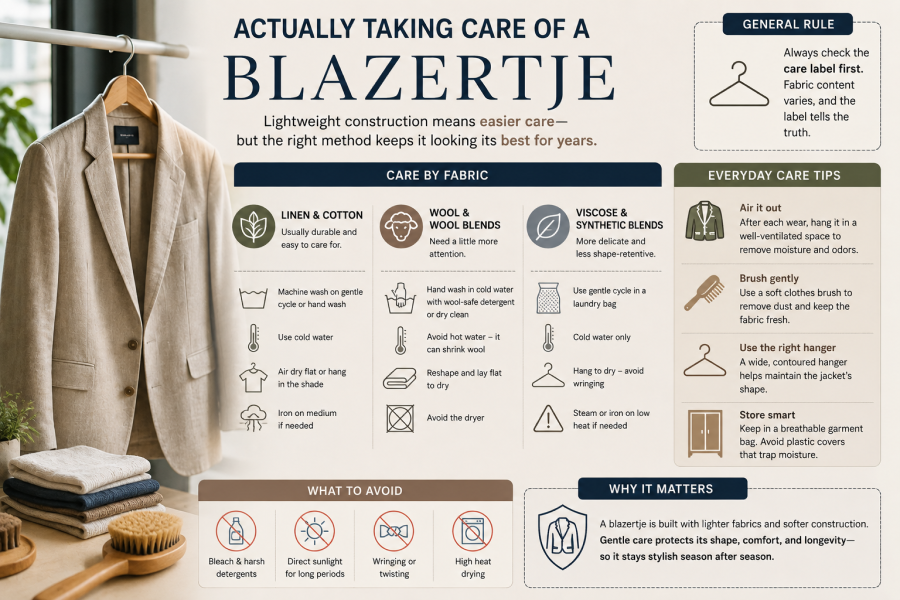
Lighter fabric generally means easier care overall than a heavy wool suit jacket demands. Read the label anyway, fiber content varies a lot piece to piece, more than people expect. Linen and cotton versions usually handle gentle machine or hand washing in cool water just fine.
Wool blends need more attention, dry cleaning or hand washing in cool water with a wool-safe detergent works best, since hot water and rough handling shrink wool fibers no matter what garment they’re sewn into. Drying flat instead of hanging wet or tossing it in a dryer keeps the shape intact rather than letting it stretch or shrink unevenly over time.
Frequently Asked Questions
What does blazertje mean?
Dutch for little blazer, blazer plus the diminutive suffix -tje. Lighter and less structured is really the point, not strictly smaller.
Is it just a cropped blazer?
Not exactly, no. Cropped length shows up often enough, sure, but the real defining feature is the unstructured build itself, and that can exist at plenty of different lengths.
Can this be worn somewhere formal?
Generally not as a stand-in for a fully structured suit jacket. It’s built for casual or business-casual settings instead, smart-casual at the most formal end.
What fabric works best overall?
Linen or cotton if it’s warm out, lightweight wool or a wool-linen blend for something that holds up across seasons. Typical weight lands around 200 to 280 grams per square meter.
How should the fit compare to a regular blazer?
Shoulder seam right at the natural shoulder, zero bunching. There’s barely any padding here to hide fit problems, so it needs a closer, more exact fit than something heavily structured would.
Bottom Line
A blazertje isn’t just a smaller regular blazer. It’s a genuinely different construction, built around comfort and versatility rather than formal structure. Lighter fabric, little to no padding, a softer build overall. Fit matters more here specifically, since there’s so little internal structure to cover for a shoulder or sleeve that isn’t quite right.
Pick the fabric based on climate and how often it’ll actually get worn. Nail the shoulder fit before anything else. Do that, and it earns its spot in a wardrobe fast.
Ran into another word online with a hazy definition? Our breakdown of Lufanest covers the same kind of digging, sorting a genuine meaning out from whatever’s been guessed at across the web.
[…] phrasing. That’s usually a decent sign the translation holds up. The same pattern shows up in Dutch fashion terms like blazertje, where a base word plus a suffix changes the meaning predictably. A “vuilniswagen” […]