
Quick Answer: What Is Seekde
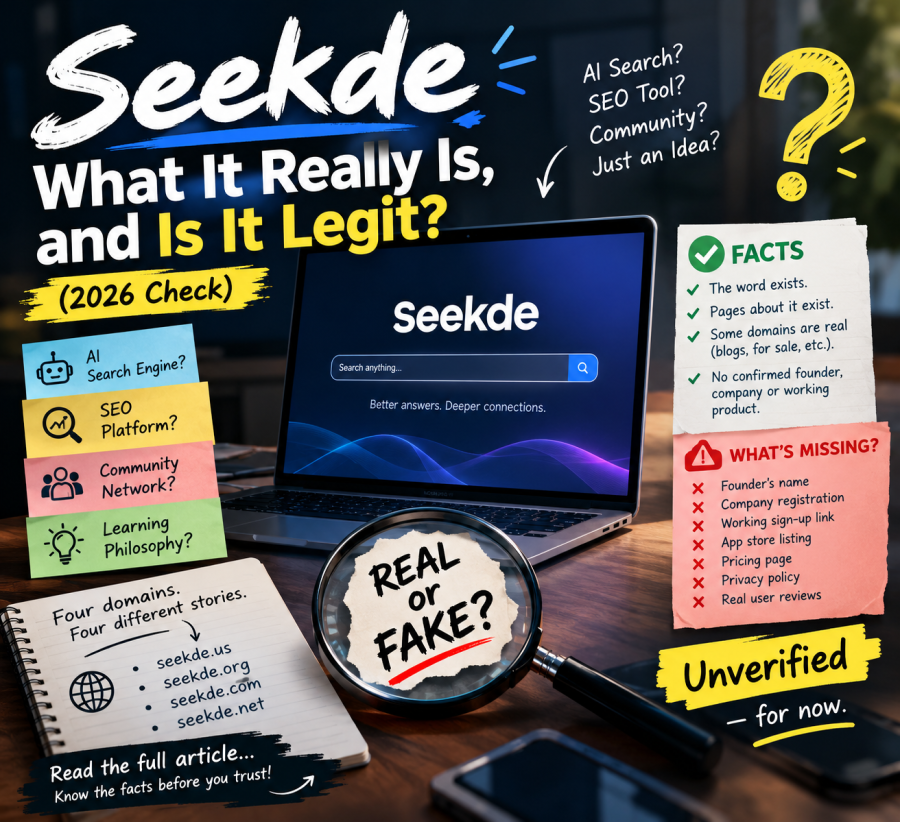
Seekde keeps popping up in blog posts, and every one of them calls it a clever new AI search and learning platform. So I went looking for the actual product. Couldn’t find it. As of October 2026, none of the top pages I read names a founder, a company, a launch date or a working sign-up link, and (this is the weird part) they don’t even agree on what Seekde does.
Some say AI search engine. Some say SEO automation tool. A couple say community discovery network, and one treats it as a philosophy about learning. They can’t all be right. So this page sorts what’s documented from what’s just repeated, and then shows you how to check the rest yourself before you trust any of it.
What Is Seekde According to the Top Results
I opened ten of the pages ranking for this word, one tab at a time, and the contradictions showed up within the first three. Four different products are being described under one name.
The most common story is an AI search platform that reads your intent. It supposedly knows what you meant, links related ideas and tailors answers to you. Tesseract Academy, Shivalordimage and Alphacraftai all tell it roughly this way.
Speculativechic goes somewhere else entirely: a hybrid community platform with upvoting, “Discovery Rooms” and a “Verified Contributor Network.” Sounds neat. Not one screenshot backs any of it up.
Then Kerkt shows up and calls Seekde an AI-driven SEO and automation platform, with keyword research, backlink analysis and scheduled publishing. Whoever wrote that clearly had a different buyer in mind, someone running a website, not someone with a question to answer.
The vaguest version is a magazine-style page that treats Seekde as a concept, “a smarter way of approaching knowledge.” Twenty one-word section headings, and no product anywhere in sight.
So when four pages describe four different things, my guess is that nobody is describing something they’ve actually used.
Seekde Websites Compared: Which Domain Is the Real One
Here’s where it gets messy. Several domains carry the name, and they don’t point to the same thing. I checked what I could reach.
| Domain | What I found |
|---|---|
| seekde.us | A WordPress blog covering crypto, SEO, video game guides and fashion accessories. No product. |
| seekde.org | Marketing copy about a “learning platform,” a search box that returned “No results,” and unrelated gambling links injected in several languages. |
| seekde.com | A domain-for-sale listing on a marketplace, priced at $3,000 when I checked. |
| seekde.net | Cited by one review as the platform’s home. My check couldn’t load it, so I can’t confirm what’s there. |
One review even links to “seekda.com” as the official site. That’s a different spelling, and it’s an easy way to send a reader to the wrong company entirely.
A real product tends to have one home, one company page and one login. Four domains, no named owner and a for-sale sign look like a pattern, not a platform. We saw a similar spread of lookalike domains when we checked ConnectionCafe.com.
Is Seekde Real or Legit: What Can Actually Be Verified
Three things get blurred together here, and I want to pull them apart. The word exists. Pages about the word exist. Whether a product exists is the open question.
The first two are easy. People search the word, which is exactly why pages keep appearing, and a few went up as recently as mid-2026. The product is where I hit a wall.
Think about what real companies leave all over the internet without trying: a founder’s name, a registered business, coverage from an actual newsroom, an app store listing, a pricing page, a privacy policy tied to a working service. I looked for each of those and came up empty. Independent hands-on testing? Nothing there either.
Two reviews deserve credit for being straight about it. Hubstero’s review calls Seekde “not a scam, not proven either.” Shivalordimage lists ownership, pricing, privacy and benchmarks as still missing. They’re the exception, and honestly the only two pages I’d bother rereading.
So, is Seekde legit? I can’t call it a scam and I can’t call it real. “Unverified” is the only label the evidence supports, and I’d rather hand you that than a confident guess dressed up as an answer.
Is Seekde Safe to Use
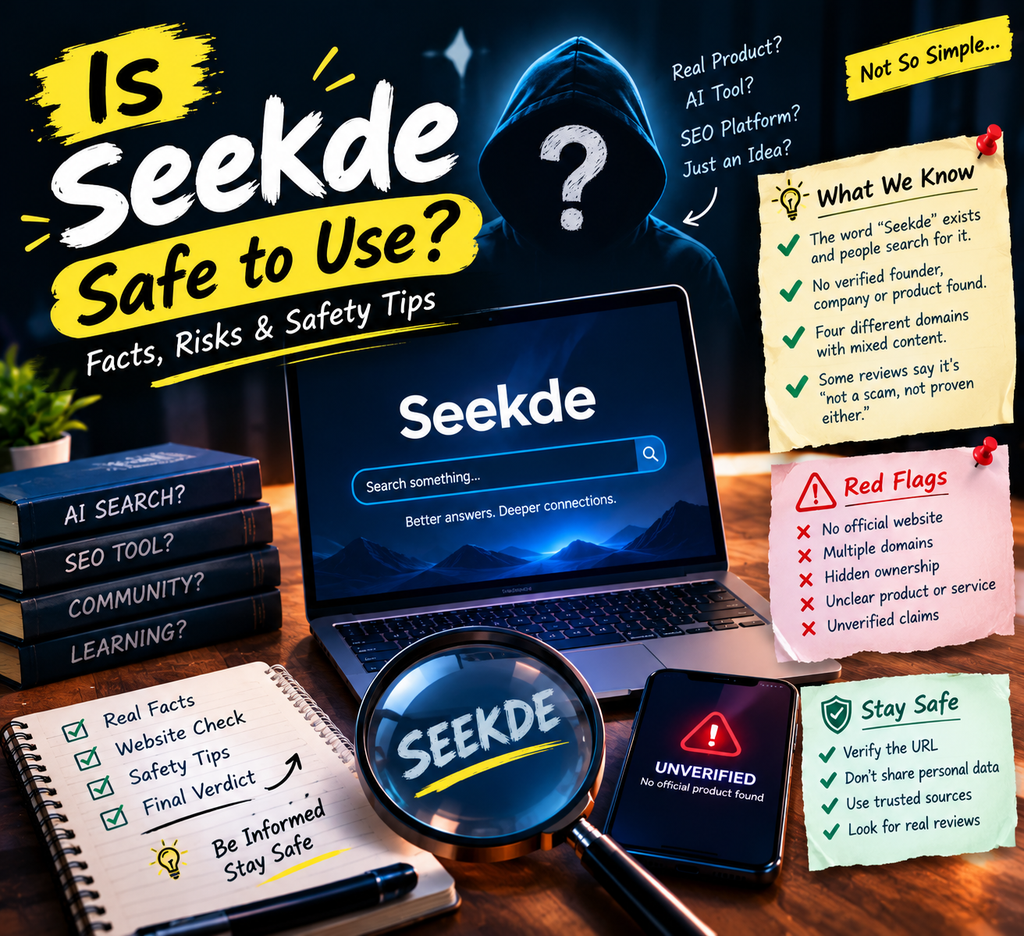
It depends which Seekde you mean, and that’s the whole trouble. Since I can’t point you to a single official site, the best I can do is show you how to protect yourself.
Before you open any of them, paste the address into Google’s Safe Browsing site status tool and see if it’s been flagged. Never give a site called Seekde your password, payment details or personal documents. Don’t reuse a password from another account, either. And if a page asks you to install an extension, download an app or connect your Google or Notion account, just close the tab.
The seekde.org page bothered me most. When a site has betting links stuffed into its code, it has either been hacked or is being used for link spam, and I wouldn’t type anything personal into it either way.
Still curious? Fine. Use a throwaway email, ask something low-stakes and watch whether the answers cite real sources. Then check every claim against a source you already trust, and be extra careful with anything medical, legal or financial.
Seekde vs Seekee, Seekr and Seekda: Don’t Mix Them Up
Part of the confusion comes from lookalike names. In the reviews I read, at least three other brands get tangled up with this one.
Seekee is a mobile app listed on Google Play. Seekr is a separate AI platform focused on news. Seekda is a different spelling that one review used for its “official” link. None of them is the same company, and none should be assumed connected to this keyword.
It happens whenever a made-up or barely documented name starts ranking. We saw the same thing with InstaPV, where several different domains were blended into one imaginary brand. If a review can’t tell you exactly which website it means, don’t trust the review.
Seekde vs Google, ChatGPT and Perplexity: A Fair Comparison
Nearly every top page has a “Seekde vs Google” table. They all say Seekde reads intent better, shows its sources and gives organized answers. Funny thing is, Google, ChatGPT and Perplexity say the same about themselves, and you can test each of those today.
| Feature | ChatGPT | Perplexity | Seekde | |
|---|---|---|---|---|
| Public product you can open | Yes | Yes | Yes | Unconfirmed |
| Named company | Yes | Yes | Yes | None found |
| Published privacy policy | Yes | Yes | Yes | Not found for a working service |
| Independent testing | Extensive | Extensive | Extensive | None found |
One page says tasks that take thirty minutes with ordinary search take ten to fifteen on Seekde. It gives no test, no sample size, no method. A number like that is invented to sound scientific.
Set something you can use next to something you can’t, and you don’t have a comparison. You have a sales pitch with a table.
What Competitor Articles on Seekde Get Wrong
After reading the top results side by side, a few problems stood out. Some aren’t small.
One page hedges and promotes in the same breath. It leans on “appears,” “possibly” and “rumored,” then wraps up by calling Seekde “a promise worth seeking.” Pick a lane.
Another guesses at the name. The theory is that “seek” got blended with “de,” maybe from “decentralized,” “discovery” or a German word. That’s a guess about a word, and it tells you nothing about a product.
The links are strange too. In one article the “Seekde” link goes to an unrelated page. Another sends you to a calculator for a totally different topic, and a third hides a Google link behind the word “authority.” One page even still showed a leftover prompt asking the owner to install a plugin, which is hard to explain unless nobody read it before publishing.
Some of these posts are plain templates. A page on a magazine-style site shares its exact structure with sibling posts about other obscure names, so you could swap the noun and the post would still work. That’s the signature of mass-produced content, the kind Google’s own guidance on helpful, reliable, people-first content tells creators to avoid.
Why Seekde Keeps Ranking Even Without a Product
If nobody can show a product, why do so many pages rank? It has less to do with Seekde than with how content sites work.
A fresh, odd word has almost no competition. Whoever publishes first with “what is” in the title collects the traffic, and everyone else copies the layout. Each new post then cites the older ones, or nothing at all, and the loop feeds itself. By the time you search, ten pages exist and every one of them quietly assumes the others did the research.
Plenty of them also read like machine writing. They repeat “not just X, but Y,” stack up words like “groundbreaking” and “cutting-edge,” and never include a screenshot. Google’s spam policies describe scaled content abuse as publishing lots of pages mainly to rank, whether people or automation write them. A topic with no real product behind it is exactly where that shows up.
We documented the same mass-publishing pattern in our Fentomagazine.com review. None of this proves the people behind the name are dishonest. It does mean volume isn’t evidence, because ten pages repeating one claim is still one claim.
What Would Prove Seekde Is Real
I’d gladly update this page if the evidence changed. Here’s what it would take, and every item is something a real company produces without much effort.
Start with a named company or founder you can find outside the Seekde pages themselves. Add a domain registered to that company, with a working sign-up and a login page. Then a published privacy policy that explains what happens to your questions and how to delete them, and the FTC’s privacy and security guidance is a fair benchmark for what a service should disclose. Pricing you can read before creating an account would round it out.
Independent proof helps too. That could be a hands-on review with screenshots and real queries, coverage from a newsroom with its own reputation, or a listing in an official app store. One or two of these would move Seekde from unverified toward plausible. Zero of them, after months of articles, says plenty.
Frequently Asked Questions
I went looking for Reddit threads asking about Seekde and found none I could verify. That tells you something on its own, because a product people actually use usually collects complaints and workarounds. The questions below are the ones competitor FAQ sections and search suggestions keep circling, answered from what’s documented.
Questions About Whether Seekde Is Legit
What is Seekde? A name many blog posts use for an AI search or learning platform. Nobody has independently demonstrated an official product.
Is Seekde a scam? There’s no proof of one. There’s no proof of a real product either, so the safest label is unverified.
Is Seekde a real search engine?
Nobody I found has shown a working search engine under this name. One site’s search box just returned “No results.”
Is Seekde the same as Seekee or Seekr?
No. Those are separate brands with their own apps and companies.
Who owns Seekde?
Unknown. No page I read names a founder, a company or a registration.
Questions About Using Seekde
Is free? Nothing reliable documents the pricing. Pages that mention a free tier don’t give a source.
Is better than Google? Nobody can test that, since there’s no confirmed product to test. Distrust any table that claims otherwise.
Is safe? Treat every site using the name as untrusted, and don’t enter personal data, passwords or payment details.
Does have an app?
No official app listing turned up when I checked.
Should I use ?
Not until it has a named owner, a privacy policy and independent reviews. A free search engine you can verify already exists.
How to Check Any Platform Like Seekde Yourself
You don’t need special skills for this. Five quick checks catch most of these cases.
Begin by looking up the domain on ICANN’s registration lookup to see when it was created and who runs it. Next, look for a company name, a physical address and a contact method that isn’t just a form. After that, search for coverage from actual newsrooms rather than other blogs.
Then check the app stores for an official listing. Finally, read the privacy policy, because a real service has one and a fake one usually doesn’t. If three of the five come back empty, walk away.
We ran the same method on ConnectionCafe.com and Fentomagazine.com. In both cases the pile of articles was bigger than the pile of evidence.
Bottom Line:
As far as anyone has shown, Seekde is a keyword and not a product. Many pages describe it, none of them agree, and not one has demonstrated a working service, a named owner or a privacy policy. The few honest reviews call it unproven, which matches what I found after a lot of tab-hopping.
If you’re curious about intent-based AI search, try tools that exist and can be verified today. And if you do find a real Seekde with a named company and independent reviews, send it my way, because that would change this page and I’d want to update it. Until then, treat anything promising big results from it as marketing.