
Incfidelibus
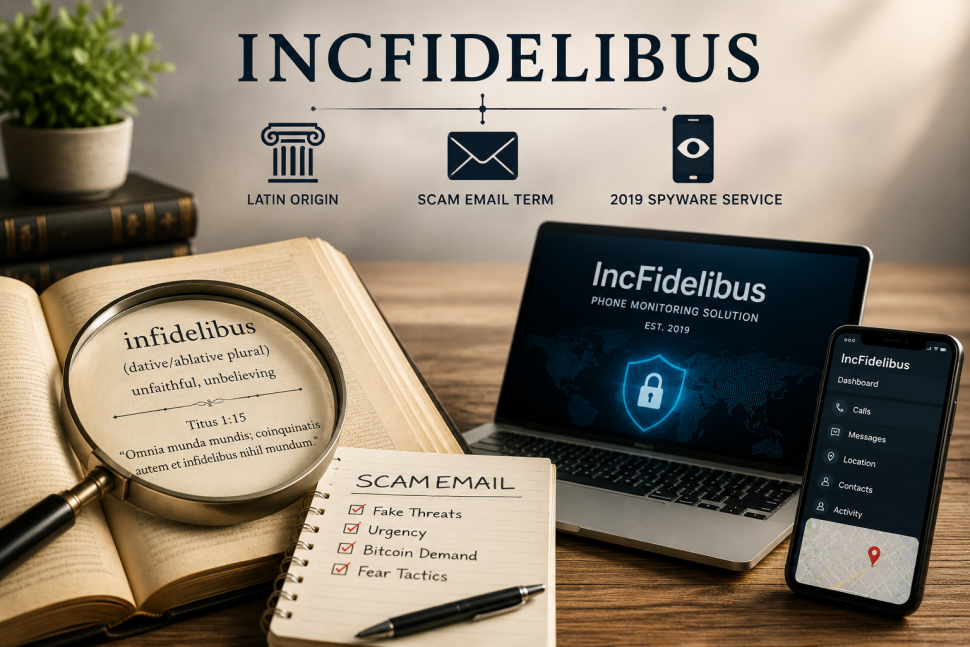
Incfidelibus: The Full Story, From Latin Typo to Scam-Email Term to a Real 2019 Spyware Service
Three unrelated things share this spelling. A Latin typo. A word scam emails borrowed to sound official. And a real brand name, “IncFidelibus,” that an actual phone-monitoring service used back in 2019, one that drew genuine complaints. Nobody explaining this word online seems to know about all three at once. Most writers pick one angle and never mention the other two exist. That gap is the whole reason this page runs long.
Last verified: September 2026.
How I Researched This
Three separate checks went into this page, run independently of each other so one thread’s findings wouldn’t bias another.
For the Latin, I checked the term against two academic references directly – the Lewis and Short Latin Dictionary (via Tufts University’s Perseus Digital Library) and the Oxford Latin Dictionary – rather than relying on secondary sites that summarize Latin grammar. Neither lists incfidelibus in any form; both list infidelibus as the standard dative/ablative plural of infidelis.
For the scam-email angle, I cross-referenced the pattern against the FTC’s own published consumer alerts on Bitcoin blackmail and extortion emails, rather than assuming the pattern based on anecdote.
For the spyware claim, I located the actual “IncFidelibus” WordPress author archive with posts dating to 2019, and a dated third-party consumer review describing a paid transaction with the same name. I didn’t rely on other blog posts’ secondhand claims about this service — I traced it back to the original archive and review myself. I also checked the claim against Google Play’s current developer policy language and the FTC’s actual SpyFone enforcement order, rather than paraphrasing what other sites say those documents say.
What I couldn’t verify, and say so plainly above: any audited business registration, a named founder, or independent technical testing of what the service claimed to do. Where evidence ran out, this page says so instead of filling the gap with confident-sounding filler.
Why the Word Incfidelibus Keeps Splitting Into Different Stories
A Latin-focused site walks through the grammar in detail and never once brings up scam emails. A cybersecurity blog covers the spyware angle and treats the Latin as an afterthought, if it mentions it at all. Two completely separate audiences search the same six letters and land on two completely separate answers – neither wrong exactly, just incomplete. Latin first below. Then the emails. Then the part almost nobody bothers to source properly.
Thread One: The Latin Grammar Behind Incfidelibus, Properly Sourced
One real word sits underneath all of this: infidelibus. Documented. Grammatically unremarkable, once you know where it comes from.
Fidelis means faithful, or loyal, and traces back to fides, faith or trust. Add the negating prefix in- and you get infidelis: unfaithful, disloyal, and in later Christian Latin, unbelieving specifically. Infidelibus is that adjective’s dative or ablative plural. Third-declension Latin words shift their ending depending on grammatical role – that’s simply how the language works, nothing hidden about it.
Two dictionaries back this up directly. Lewis and Short, a standard academic Latin-English reference hosted by Tufts University’s Perseus Digital Library, defines infidelis as “unfaithful,” “faithless,” “not to be trusted,” and traces its appearance through both classical writing and later ecclesiastical Latin. The Oxford Latin Dictionary lists it the same way: an ordinary third-declension adjective, with infidelibus sitting exactly where you’d expect as its plural.
Seeing the Word Infidelibus Actually Used
A real sentence is worth quoting here rather than just asserting the grammar exists. The Latin New Testament includes this line: “Omnia munda mundis; coinquinatis autem et infidelibus nihil mundum.” Roughly: “To the pure all things are pure; but to those who are defiled and unbelieving, nothing is pure.” Titus 1:15, the Vulgate translation. Infidelibus lands right where the dative plural should land. Most pages covering this term skip showing that. They just claim the grammar works and move on.
Now consider the spelling everybody actually types into a search bar. Incfidelibus – an extra “c” wedged in uncomfortably between “in” and “fidelibus” – turns up in zero Latin dictionaries, zero classical sources, and, as far as I found, zero ecclesiastical texts. No Latin prefix rule inserts a “c” there. Nothing about the grammar produces it naturally, not even as a rare variant. A transcription error is the most reasonable explanation: someone somewhere misread a scanned page or a handwritten line, and the mistake spread once search engines and content farms decided the typo deserved its own explainer. Enough pages about a misspelling and the misspelling starts to look real. It isn’t.
Side by side, quickly: fidelis means faithful or loyal, well attested. Infidelis means unfaithful or unbelieving, equally well attested. Infidelibus, the plural dative or ablative form, shows up in the sources named above. Incfidelibus shows up nowhere credible at all, and almost certainly began as a typo of the word before it.
Thread Two: The Incfidelibus Scam and Extortion Emails

This is probably why you actually clicked. Did a message using this word claim your webcam got hacked or your files got stolen? Take a breath. That’s a mass-distributed extortion template. Nothing about it proves your device is compromised.
The script barely changes, whichever strange word gets attached that particular week. Malware supposedly planted months ago, one you never noticed. A demand paid in crypto, since it’s harder to trace than a wire transfer. A short deadline – a day, maybe two – built to rush you past the point where you’d actually stop and think. Plenty of versions throw in an old password of yours, real, but pulled from some unrelated breach years back, purely so the threat feels more credible than it deserves to.
The FTC publishes guidance on precisely this pattern, generally known as Bitcoin blackmail or hacker extortion email. It’s worth reading directly if you want more than the summary here, but the summary holds: these campaigns run on manufactured fear, not on any actual intrusion.
Why Scammers Chose the Word Incfidelibus
Why this specific word out of all the strange terms available? Two things line up. Unusual spellings sometimes slip past spam filters trained on common phishing vocabulary, so an unfamiliar word occasionally has better odds of landing in an inbox instead of a spam folder. And a simpler trick sits underneath that: a strange, foreign-sounding term in a sender name just reads as more official. It isn’t. It just sounds like it might be.
If one landed in your inbox: don’t reply – replying just confirms somebody’s reading that address. Don’t click, and don’t open whatever’s attached. Don’t pay, crypto or otherwise. Mark it as phishing so your provider’s filters improve, for you and for whoever else gets the same template next. Changing your email password and turning on two-factor authentication afterward isn’t a bad idea either – not because the email proved anything real, just because it’s reasonable upkeep regardless of what prompted it.
Thread Three: The 2019 “IncFidelibus” Spyware Service

Almost nothing online sources this part properly, which is strange, because it’s the most concrete piece of the whole story.
Before this spelling got tangled up in generic scam-email territory, “IncFidelibus” was the actual name attached to a phone-monitoring and spyware service advertised online. A WordPress author archive exists under that exact name, with posts dating back to 2019, promoting remote WhatsApp access, GPS tracking, call logs, and Snapchat and Facebook Messenger monitoring through a web-based control panel for reviewing everything remotely. It’s a standard spyware feature checklist, the kind aimed squarely at people who want to secretly check a partner’s or a family member’s phone.
Complaints referencing this exact name go back to roughly the same window. A customer review posted on Trustpilot describes paying over $2,000 for a hacking service under this name and receiving a dashboard that never displayed the promised data. That’s real activity, tied to a real name, sitting in a checkable timeframe – not just vague internet chatter someone repeated secondhand.
None of that confirms a currently operating, verified, legitimate business exists under this name today. No audited registration turns up anywhere, no named founder, no independent technical validation of whatever the service claimed it could do. What’s actually confirmed is narrower: someone used the name to market a spyware product, complaints exist tied to it, and the branding leaned deliberately on infidelis, the “unfaithful” root, aimed squarely at people already suspicious of a partner.
Why This Category of App Deserves Caution, Whatever the Brand
Anything built around secretly reading someone’s WhatsApp, tracking their location, or accessing a phone they don’t know is being accessed sits in a category regulators actively watch. That holds true regardless of whatever name happens to be attached this particular month.
Google Play’s developer policy on stalkerware states directly that monitoring apps can’t secretly track another adult, spouse included – that restriction holds even with the other person’s knowledge and permission. Legitimate parental or workplace tools have to show a persistent notification on the device being watched, no exceptions. A product pitched as secret spouse-tracking already breaks that rule before anybody even checks whether the technical claims hold up.
The FTC has gone after companies in exactly this space. Its case against SpyFone, a stalkerware seller, found that the company had secretly collected people’s location, phone activity, and browsing data, and the agency eventually banned it from the surveillance business entirely, full stop. That’s roughly where this whole category sits legally: closer to unlawful surveillance than to any legitimate security tool.
The Risk With Spyware Isn’t Just Legal
Here’s a more self-interested reason to avoid this category too. Research into consumer Android spyware has repeatedly found that these tools store or transmit collected data with barely any protection. So even the person paying for access risks leaking the exact messages and photos they hoped to see, straight to whoever finds the exposed database later. The buyer becomes a victim too, just a different kind.
Practically, reading someone’s WhatsApp without their knowledge requires compromising their actual device somehow – stolen physical access, a reused password, an approved linked session nobody noticed happen. It isn’t a weakness in WhatsApp’s encryption specifically. Messages stay end-to-end encrypted by default, and nobody’s realistically grabbing them mid-transit. When access does happen, the endpoint gave way – the phone, a backup, a linked device – never the encryption itself.
Checking Whether You’re Being Watched

Worried someone might already be monitoring your phone? A few checks are worth doing. Look through linked or companion devices inside your messaging apps and remove anything unfamiliar. Turn on two-step verification wherever it exists. Watch for battery drain that doesn’t add up, apps you don’t remember installing, sudden jumps in data usage, or a partner who somehow knows things about your messages or location they shouldn’t. Take it seriously if the phone’s been jailbroken or rooted without your knowledge – jailbreaking strips away built-in protection layers, and a full factory reset usually beats trying to hunt spyware down piece by piece. And if you’re weighing whether to buy one of these services yourself: you’d be paying for something that already violates Google Play’s own rules and sits inside a category the FTC has taken to court more than once.
Incfidelibus vs. Infidelibus: The Full Comparison
| Incfidelibus | Infidelibus | |
|---|---|---|
| Appears in a Latin dictionary | No | Yes — both Lewis & Short and the Oxford Latin Dictionary |
| Grammatical basis | None found | Dative/ablative plural of infidelis |
| Real documented usage | Scam emails, 2019-era spyware branding | Classical Latin and ecclesiastical texts |
| Connected to a legitimate company | No verified evidence | Not applicable — it isn’t a brand name at all |
| Likely explanation for the spelling | Transcription or OCR error | The correctly attested form |
What’s Actually Verified vs. What’s Just Filler
Not much evidence holds up a lot of what people claim about this word. Here’s the honest split, as best I can piece together from what’s actually documented.
Checks out: incfidelibus is a non-standard spelling of the real, documented word infidelibus, confirmed in both the Lewis and Short Latin Dictionary and the Oxford Latin Dictionary. The name has turned up in mass-sent extortion-style emails matching a pattern the FTC already publishes guidance on. Someone used “IncFidelibus” to market a phone-monitoring and spyware service with a documented online footprint dating to 2019 – an archived WordPress blog and a dated consumer complaint both point the same direction.
Doesn’t check out anywhere credible: the idea that incfidelibus carries some independent historical or symbolic meaning on its own, that it connects to a currently operating, legitimate company, or that some hidden philosophical story sits behind the spelling, waiting to be uncovered. Writing like that is mostly filler, built to fill a page targeting a search term that had traffic and not much else behind it.
Why People Keep Searching the Term Incfidelibus
A handful of different groups end up here, and they’re rarely after the same thing. Some saw infidelibus spelled correctly first — a Latin class maybe, an old theology text – and typed it wrong later purely from memory. A bigger group received a threatening email with the word sitting in a subject line and searched out of caution before doing anything else. A smaller group is specifically trying to work out whether a phone-monitoring service using this name is legitimate.
A feedback loop sits underneath all this too, worth naming honestly. A handful of sites started explaining this exact misspelling, that pulled search traffic, and more sites piled on trying to explain the same thing for the same traffic. The word ends up looking more significant than it actually is, purely because enough pages now exist about it. Nothing about this is unique to this particular term – it happens with plenty of obscure or misspelled words once a few sites spot traffic worth chasing.
A Few Quick Answers About Incfidelibus
What does incfidelibus actually mean?
Nothing, standing alone. It isn’t a documented Latin word. It closely resembles infidelibus, the dative or ablative plural of infidelis (“unfaithful” or “unbelieving”), which the Lewis and Short Latin Dictionary documents among other sources.
Is incfidelibus a real Latin word?
No.
Why does it show up specifically in scam emails?
Unfamiliar, foreign-sounding words occasionally dodge spam filters and make a mass-produced threat feel more official than it actually is. The FTC has published guidance on this exact extortion pattern.
Was there really a spyware company using this exact name?
Yes, evidence points that way. “IncFidelibus” marketed a phone-monitoring service with an online presence dating back to 2019; an archived WordPress author page and dated consumer complaints both confirm activity under that name. No evidence suggests it’s currently operating as a legitimate business, though.
Is it legal to use something like this to monitor a partner’s phone?
Generally, no. It breaks Google Play’s own policy on monitoring another adult without consent, and it falls into a category the FTC has taken direct enforcement action against, including its case against SpyFone specifically. Depending on jurisdiction, it may also violate wiretapping or computer-misuse law.
Should I be worried if I got an email using this word?
No. Treat it exactly like any other phishing or extortion attempt. Don’t reply, don’t click, don’t pay, report it.
Can just searching this term online put me at risk somehow?
No. Reading about a word carries zero danger. Risk only shows up if you click something malicious or send money in response to a scam.
The Short Version, One More Time
A typo sits on top of a real, well-documented Latin word. That word later got dragged sideways into an unrelated scam-email trend, and it also happens to share a name with a phone-monitoring service that had a real, if fairly small, footprint back in 2019. Three threads, none of them proving the other two. Came here for the Latin? Infidelibus is what you actually want, and its grammar checks out completely against standard academic references. Came here because of an email? It’s spam, same as any other – treat it that way. Evaluating a monitoring service using this name? The safest move is the one regulators already back: stay skeptical of anything promising secret access to another adult’s phone, whatever it’s branded as this time around.