

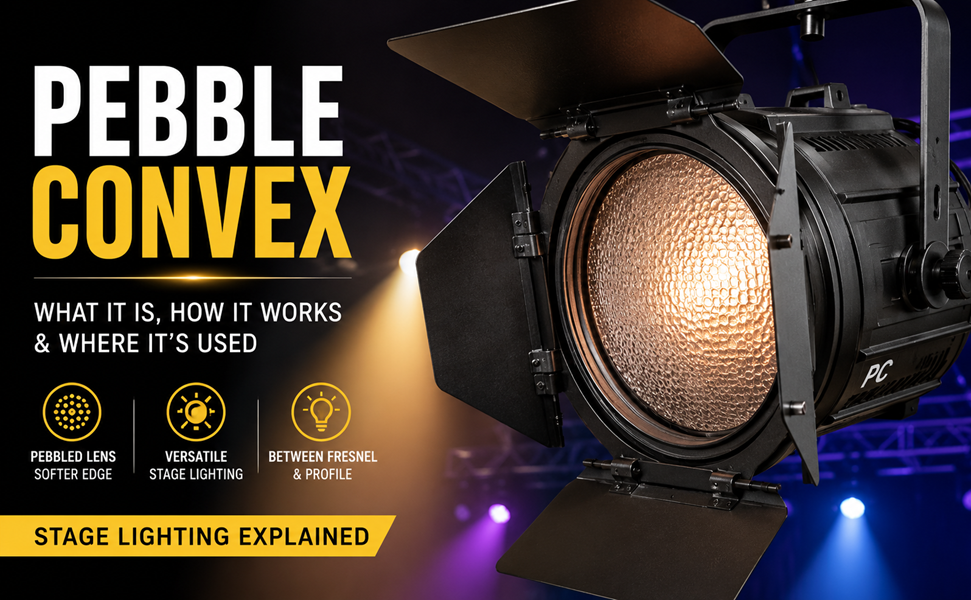
Pebble Convex is a lens design you’ll find in theatrical and studio lighting fixtures. It gives you a beam that’s tighter and more controlled than a Fresnel wash, but not as hard-edged as what you’d get from a profile spot. People just call the fixtures built around this lens “PC” — PC fixture, PC lantern, or sometimes just “the PC” on a lighting plot. If you’ve spotted that label on a rental sheet or a fixture case and weren’t quite sure what it meant, here’s the actual explanation, along with where a Pebble Convex fits next to the other lights you already know.
What Is a Pebble Convex?
Start with the lens itself. A Pebble Convex is built on the plano-convex design — flat on one side, curved outward on the other. What earns it the “pebble” part of the name is that flat side. It’s not smooth glass. It’s got a fine, stippled texture pressed into it, almost like the surface of a worn pebble rather than a clear windowpane.
That texture isn’t decorative. It changes what the beam looks like. A smooth plano-convex lens throws a hard-edged beam, and it tends to show color fringing right at that edge — a rainbow-ish ring caused by how a plain curved surface bends different wavelengths slightly differently. Stipple the flat side, and that light gets scattered just enough to soften the edge and calm down the fringing. It doesn’t turn into full diffusion, the way a Fresnel would. It’s a middle setting.
How Does a Pebble Convex Lens Work?
Nothing exotic here, mechanically speaking. Like most stage fixtures, there’s a lamp, a reflector behind it gathering and redirecting the light forward, and then the lens out front doing the shaping.
The convex curve handles the main focusing job — that part works about the same as it does in a Fresnel or a plain plano-convex spot. Where things diverge is at that flat side. Smooth glass keeps the edge crisp. The pebbled texture scatters some of those rays as they pass through, and that’s what blurs the transition at the beam’s edge just enough to make it easy on the eyes, without losing the beam’s overall shape.
Most PC fixtures also let you slide the lamp-and-reflector housing closer to or farther from the lens. That’s your focus control — tighter spot, or wider flood. It’s a separate adjustment from the texture doing the edge-softening; one changes how much light the lens is catching, the other changes how that light exits.
Why Is the Lens Called “Pebble Convex”?
Pretty literal, actually. “Convex” is just the curve. “Pebble” describes that stippled flat surface — it looks and feels closer to a smooth stone than clear glass.
There’s no single well-documented origin story here — no manufacturer or specific year that gets credited for it in the sources I could find. The term’s just been floating around theatrical lighting catalogs and shop talk long enough that it stuck. If you’re hunting for the precise history of who first textured a plano-convex lens this way, that’s a narrower question than general lighting references tend to cover.
What Does PC Mean in Stage Lighting?
Usually, Pebble Convex. But the letters have a bit of a messy past. Depending on the source or the era, you’ll also see “PC” explained as Plano Convex, or occasionally Prism Convex. All three describe closely related lens families — a curved lens, paired with some kind of treatment on the flat side (texture, or in some older designs, faceting) to manage that beam edge.
Practically speaking: if someone hands you a rider or a lighting plot that just says “PC” with no further explanation, assuming Pebble Convex is a safe bet in most modern theatre and event settings.
Where Is Pebble Convex Lighting Used?
Anywhere a lighting designer wants a beam that’s controllable but still blends easily with the light around it. That covers a lot of ground:
- Theatre productions — general acting-area lighting, stage washes
- School and community auditoriums — where crews often want something reliable and easy to focus, without setting up a profile spot’s precision rig
- TV and video studios — same logic, smooth coverage that doesn’t leave hard shadow lines across the frame
- Concert and live event production, especially smaller and mid-sized venues, though bigger touring rigs lean more toward LED moving lights these days
The pattern across all of it: general, directional coverage that doesn’t announce its own edges.
Pebble Convex vs Fresnel
A Fresnel uses an entirely different lens — stepped, ridged, and built to produce a very soft, near-invisible beam edge. Great for broad washes that need to blend into everything around them. Not so great if you care exactly where the light stops; Fresnels spill more than a PC does.
Pebble Convex steps up a notch on definition. The edge is still soft, but it’s more contained, more directional. When a Fresnel feels too loose for what you need, a PC is often the next thing to reach for.
Neither wins outright. It comes down to whether you want that seamless Fresnel blend, or a bit more shape while staying visually soft — that’s the PC’s job.
Pebble Convex vs Profile Spotlight
Profile spotlights (also called ellipsoidal reflector spotlights, or ERS) are the precision tool. Shutters cut hard-edged shapes into the beam, and most accept gobos for patterns or textures. Sharp, deliberate edges — that’s the whole point of a profile.
A Pebble Convex doesn’t try to compete on that front. No shutters, no gobo work. What you get instead is a simpler beam that’s easier to blend across a stage, without the crisp lines a profile leaves behind.
Rough rule of thumb: profile when you need to control exactly where the light ends, PC when you want general coverage that doesn’t call attention to its own boundary.
Quick Comparison :
| Feature | Pebble Convex | Fresnel | Profile |
|---|---|---|---|
| Beam edge | Soft but defined | Very soft, diffuse | Sharp, hard-edged |
| Beam control | Moderate | Low | High |
| Shutters | Usually no | Usually no | Yes |
| Gobo projection | No | No | Yes |
| Typical use | General stage/acting-area coverage | Broad washes | Precise spotlighting and shaping |
Treat this as general tendencies, not a spec sheet — actual performance shifts a bit depending on manufacturer, lamp source, and how worn the lens is.
What Are the Advantages of Pebble Convex Lighting?
- Fills the gap when a Fresnel spills too much light and a profile is more precision than the scene calls for
- Softens the beam edge, which cuts down on harsh, distracting shadows across performers
- Less color fringing than you’d get from a plain, untextured plano-convex lens
- Simpler to run than a profile — no shutters or gobo holder to fuss with
- Focus is adjustable on most models, so one fixture can cover a tight spot or a wider area
What Are the Limitations?
- Can’t hard-edge or shape the beam the way a profile can
- Doesn’t blend as invisibly into a broad wash as a Fresnel does
- Not built for gobo work or textured projection
- Beam character varies some between manufacturers, and lenses can degrade with age
- Modern LED fixtures with electronic beam-shaping have picked up some of the work PCs used to handle on bigger productions
Are Pebble Convex Lights Still Used Today?
Yes — still common in theatre, school, and community venues, and still stocked by plenty of rental houses and manufacturers. They haven’t gone anywhere, though their role has shifted a bit as LED and moving-light tech has opened up more options on larger stages. In smaller venues and educational settings, where budget and straightforward reliability matter more than programmable effects, PCs are still a practical, frequently chosen fixture.
Pebble Convex in Modern LED Stage Lighting
“Pebble Convex” describes an optical idea — a lens shape plus a surface treatment — not a specific type of lamp. So it isn’t locked to old-school incandescent or tungsten-halogen sources. Some modern LED fixtures aim for a similar soft-but-directional beam, either through comparable lens designs or through electronic diffusion and beam-shaping built into the unit itself. Whether a given LED fixture actually matches the character of a traditional Pebble Convex lens depends on its specific optics — worth checking the beam spec sheet rather than assuming “LED PC” automatically behaves like the tungsten version.
How to Choose Between a Pebble Convex, Fresnel, and Profile
Pebble Convex — when you want more shape and control than a Fresnel, but don’t need a profile’s hard-edged precision. Typical for general acting-area lighting.
Fresnel — when the goal is a soft, blended wash and precise edges just aren’t the priority.
Profile — when you need shutters, gobos, or a clean hard edge, for framing a performer or projecting a pattern.
Think of this as a starting point rather than a hard rule. Most real lighting plots mix all three across a single rig, depending on what each part of the stage actually needs.
Common Misconceptions
Misconception 1: Pebble Convex is the same as Fresnel. Related job, different lens. A Fresnel’s stepped lens produces a noticeably softer, more diffuse beam than a Pebble Convex’s textured plano-convex lens.
Misconception 2: PC always means Plano Convex. Depending on the source and the era, “PC” has stood for Plano Convex, Prism Convex, and Pebble Convex. Pebble Convex is the most common meaning today, but the term isn’t perfectly standardized everywhere.
Misconception 3: Pebble Convex produces a hard-edged beam. More defined than a Fresnel, sure. But it’s still clearly softer than the sharp cut you get from a profile.
Misconception 4: Pebble Convex fixtures can project gobos like a profile. They can’t — no shutter hardware, no gobo slot. That’s not what this lens is built for.
Misconception 5: Pebble Convex is outdated equipment nobody uses anymore. It’s an older design, yes, but it’s still in active use, and the same basic optical idea shows up in some modern LED fixtures too.
Frequently Asked Questions
What is a Pebble Convex?
A Pebble Convex is a stage lighting lens with a curved outer surface and a pebbled or stippled flat side, used to produce a beam that’s softer than a profile spotlight’s but more defined than a Fresnel wash.
What does Pebble Convex mean in stage lighting?
It refers to the lens design itself, and informally to the fixtures built around it — usually called PC fixtures or PC lanterns.
What does PC stand for in theatre lighting?
Most often, Pebble Convex. Historically it’s also been used for Plano Convex and Prism Convex, depending on the source.
How is Pebble Convex different from Fresnel?
A Fresnel’s stepped lens produces a very soft, diffuse beam with barely any edge definition. A Pebble Convex gives you a more controlled beam that’s still soft-edged, just less so.
How is Pebble Convex different from a profile spotlight?
A profile has shutters and gobo capability for sharp, shaped beams. A Pebble Convex is simpler — softer edge, no shaping hardware.
What is a Pebble Convex lens used for?
Mainly general acting-area and stage lighting, where you want a controllable beam without the harshness of a hard-edged spot.
Are Pebble Convex lights still used?
Yes. Still common in theatre, school, and community venues, and still available from manufacturers and rental houses despite LED and moving-light fixtures taking over more of the market.
Can a Pebble Convex light produce a sharp beam?
No, not really — the lens is specifically built to soften that edge, so it won’t give you the crisp, shutter-cut lines a profile fixture produces.