

Buy the wrong “Wollmatte” once, and you’ll understand why this guide exists. Someone orders a yoga mat expecting cushioning and grip, and what shows up is a stiff felt panel built for a wall, not a floor. That mix-up happens constantly, and it’s not really the buyer’s fault.
Wollmatten. It’s just German for wool mats – Wolle plus Matten stuck together. But here’s the thing: it’s not one product. It’s an entire category, and that category runs from a soft little yoga mat all the way to a dense insulation panel hiding inside somebody’s wall. Look through any German, Austrian, or Swiss retail site and you’ll see the word everywhere. Most people assume it points to exactly one kind of thing. It doesn’t, and honestly that wrong assumption probably causes more buyer disappointment than anything else tied to this topic.
What follows covers every major type out there, the fiber numbers that actually decide how well a mat performs, which certifications are worth your time, real pricing (not the vague kind), and how to stop one from falling apart too soon. All pulled from textile and wool-industry sources – not the same three recycled paragraphs you’ll find copy-pasted across a dozen other sites.
Quick Answer
Wollmatten means wool mats. It’s a category, not a single product. Floor rugs, yoga mats, mattress toppers, felt sheets for furniture and crafts, acoustic panels, even building insulation – all of it falls under this word, as long as it’s made fully or partly from sheep’s wool. What actually separates a good one from a bad one? Fiber fineness, density, backing, certification. Not whatever’s printed on the listing title.
Where the Word Comes From
It’s a compound word, nothing complicated about it. Woll- comes from Wolle, matten from Matte, then pluralized. The etymology was never the confusing part. What trips people up is that this one word gets stretched across wildly different products – so a “Wollmatte” listing might mean a yoga mat on one site and a full mattress topper on the next.
The Actual Types, One by One
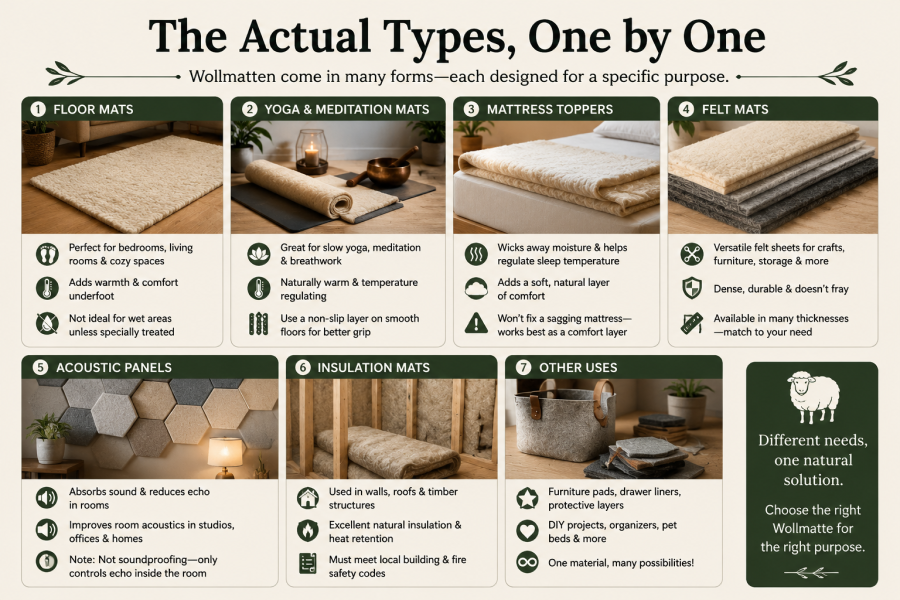
Yoga and Meditation Mats
Yoga and meditation mats tend to suit slower practice – restorative work, breathwork, the kind of session where warmth matters more than grip. Wool just holds temperature better than synthetic material through a long, still practice. That said, a smooth studio floor often needs something non-slip underneath, since wool by itself doesn’t grip a whole lot.
Mattress Toppers
Mattress toppers work a bit differently. You’re looking at compressed wool layers, usually wrapped in cotton, sitting over or built into the mattress. The moisture-wicking helps regulate the sleeping surface overnight. But don’t expect a thin topper to save a mattress that’s already sagging badly – that’s not a fight it can win.
Felt Mats
Felt mats are made from pressed fiber. Dense, doesn’t fray, sold by the sheet, the roll, or cut custom to size. You’ll find these as furniture pads, wall coverings, storage lining, craft material – the list goes on. Thickness varies a lot here. A thin decorative piece won’t protect anything the way heavy industrial felt does, so match the piece to the job.
Acoustic Panels
Acoustic panels lean on that same dense felt to soak up sound bouncing around hard surfaces – cutting down echo in studios or offices that have too much glass or bare wall. Worth being careful with one distinction here: absorbing echo inside a room isn’t the same as soundproofing, which stops sound from crossing into a different space altogether. Two completely different jobs.
Insulation Mats
Insulation mats go into walls, roofs, timber structures – anywhere wool’s natural crimp can trap air and slow heat loss. These need to clear local building and fire codes before anything else. A decorative mat you picked up for the living room floor should never double as certified insulation. That’s not what it’s built for.
What the Micron Number Actually Means
Most guides covering this topic go soft right at this point – they skip past the one number that matters more than anything else. Wool fiber diameter is measured in microns, and the lower that number sits, the finer the fiber is.
Ultrafine merino stays under 15.5 microns. Rare, expensive, mostly kept for luxury goods rather than mats. Fine to superfine sits around 15.5 to 21 microns, and that’s your range for anything touching skin over long stretches – yoga mats, bedding toppers especially. Medium wool runs 22 to 28 microns, solid enough for general floor mats and blankets, comfortable without chasing that luxury-grade softness. Coarse wool climbs past 29, sometimes touching 40, and that’s where rugs, heavy felt, and insulation belong – spots where toughness matters more than how soft it feels. For scale, human hair runs 50 to 80 microns. Even coarse wool stays well under that number.
If a listing doesn’t mention a micron count anywhere, that’s worth a second look. It’s honestly the clearest single number for figuring out what a mat was actually built to do.
Certifications Worth Checking
Barely anyone writing about this topic bothers mentioning certifications, which is strange since they cut through vague marketing language faster than anything else. Woolmark, run by Australian Wool Innovation, confirms the wool content is real and tested – worth hunting for on anything claiming pure or high-grade wool. GOTS covers organically farmed wool processed without harsh chemicals, which matters a lot for a nursery, bedroom, or anywhere skin sits against the mat for hours. OEKO-TEX checks for harmful substances in the finished product. And specifically for rugs, look for WoolSafe-approved cleaning – a standard carpet cleaner can genuinely wreck wool fiber, and it’s better to know that before booking an appointment than after.
Real Prices, Not Vague Ranges
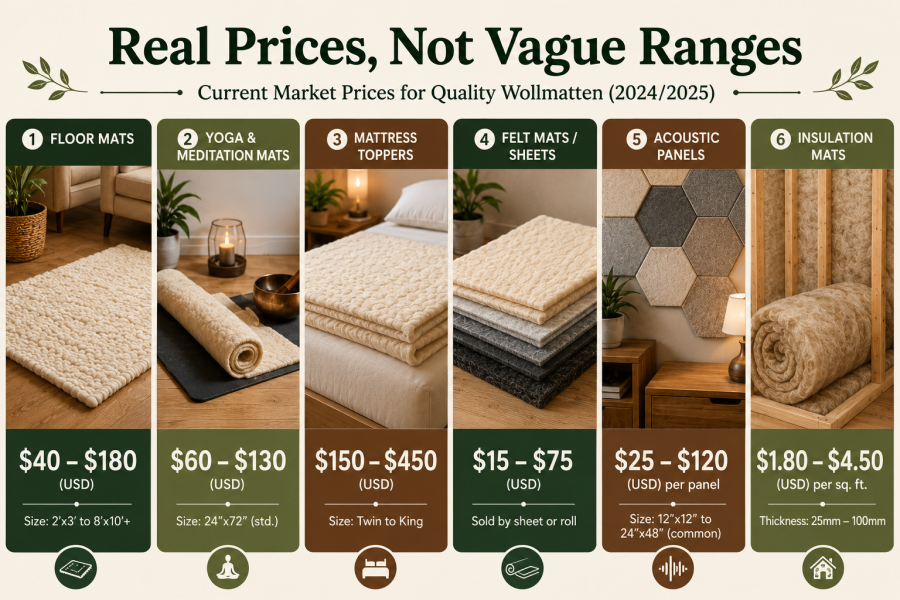
Most articles skip pricing altogether, so here’s the honest version instead. Budget felt sheets and small craft pieces land around €10 to €30, usually coarser wool or some kind of blend. Mid-range floor and yoga mats run €40 to €120 – roughly where certified, decent-quality wool starts becoming the norm instead of a lucky find. Premium rugs, toppers, and Woolmark-certified pieces climb to €150, sometimes past €400, and that price is paying for finer fiber plus tighter construction. Insulation and acoustic panels work differently – quoted per square meter by whoever handles the installation, since labor and building code eat into that number more than the raw fiber cost ever does.
Where to Buy One
Really comes down to which type you need. Carpet and flooring stores carry rugs and felt mats. Bedding and futon specialists stock the mattress toppers. Yoga stores handle the yoga-specific versions, usually with grip already built into the backing. Wool and craft suppliers sell felt by the meter for furniture pads or DIY projects, while insulation runs through building suppliers instead – it rarely shows up at a general home goods store at all.
A narrower search almost always beats typing “Wollmatten” alone. Terms like Wollmatte Yoga, Wollfilz Meterware, Wollmatte Matratze, or Wolldämmmatten pull up the right category instead of a scattered mess of results.
Why Wool Performs the Way It Does
The crimp built into wool fiber traps tiny air pockets, and that’s the actual physics behind its warmth – not just something printed on packaging for marketing’s sake. That same structure absorbs moisture vapor and releases it slowly, which is part of why it feels less clammy than synthetic material when humidity keeps swinging around. Wool also resists flame better than most common textiles, though that doesn’t make every wool product fireproof outright – backing and treatment still play a real role there. And that same irregular fiber structure that scatters air happens to scatter sound too, which is exactly why felt keeps showing up in acoustic work.
Where It Falls Short
New wool rugs shed for the first few weeks. Gentle vacuuming settles it down fairly quickly though. Cleaning needs real care as well – hot water and harsh agitation can shrink or felt the fibers permanently, same risk as any wool garment thrown into the wrong wash cycle. Cost sits higher than synthetic at a comparable size, no way around that fact. And since it’s a natural protein fiber, moths can get into it during dark, undisturbed storage, though regular airing keeps that risk fairly low.
Matching the Type to the Job
A cold bedroom floor calls for medium-grade wool, somewhere around 22 to 28 microns, paired with backing that actually grips whatever’s underneath. A home yoga practice wants something finer – under 21 microns – plus a grip layer if the studio floor tends to get slick. Upgrading a mattress means getting an actual topper, not a floor mat pressed into a job it was never built for. A noisy home studio does better with dense acoustic felt, where thickness matters more than softness. And a timber structure needing insulation should only get certified building-grade wool – nothing pulled off a craft store shelf.
Taking Care of a Wollmatte
Read the label first, every single time – blend and construction change what’s actually safe to do. Beyond that: vacuum on low, blot spills fast instead of rubbing them in, reach for a wool-specific cleaner, and test anything new on a hidden spot before committing to the whole surface. Skip the washing machine unless the label clears it explicitly. For anything valuable or badly soiled, a WoolSafe-certified cleaner beats DIY most of the time anyway.
Wool or Synthetic
Honestly, context decides this one. Wool suits buyers who want natural fiber, temperature control, moisture handling, and sound absorption – people who don’t mind the extra cost or the careful cleaning that comes with it. Synthetic makes more sense wherever frequent washing or strong water resistance matters more than the material itself. Entryways and damp spaces are the obvious case for that.
Frequently Asked Questions
What does Wollmatten mean?
German for wool mats. It’s a category, not a single product – covering floor rugs, yoga mats, mattress toppers, felt sheets, acoustic panels, and insulation.
What micron count should I look for?
Under 21 for anything touching skin regularly. 22 to 28 for general floor use. 29 and up for rugs, heavy felt, or insulation.
Can these go in a washing machine?
Only if the label says so directly. Most need spot cleaning, hand washing, or a professional instead.
Are they waterproof?
No. Wool handles small amounts of surface moisture but needs a backing layer for real water resistance.
What certifications matter most?
Woolmark for wool content, GOTS for organic processing, OEKO-TEX for chemical safety, WoolSafe for rug cleaning.
Do wool mats stop sound from leaving a room?
No – that’s soundproofing. Wool felt cuts echo inside a room, which is a different job entirely.
Bottom Line
Wollmatten covers a wide range of products, and the word by itself tells you almost nothing about quality. What actually matters: micron count, certification, backing, and whether that specific piece was built for its intended job. Floor, yoga, bedding, acoustic, insulation – none of these are interchangeable no matter what the listing title claims. Check those details before you check the price tag, and the right Wollmatte will usually outlast synthetic alternatives by a wide margin.
Fiber weight and quality matter just as much in clothing as they do in mats. Our guide to Blazertje breaks down fabric weight and fiber choice for a completely different garment – same instinct to check the numbers before buying applies there too.