

Quick Answer: What Is an Afruimwagen
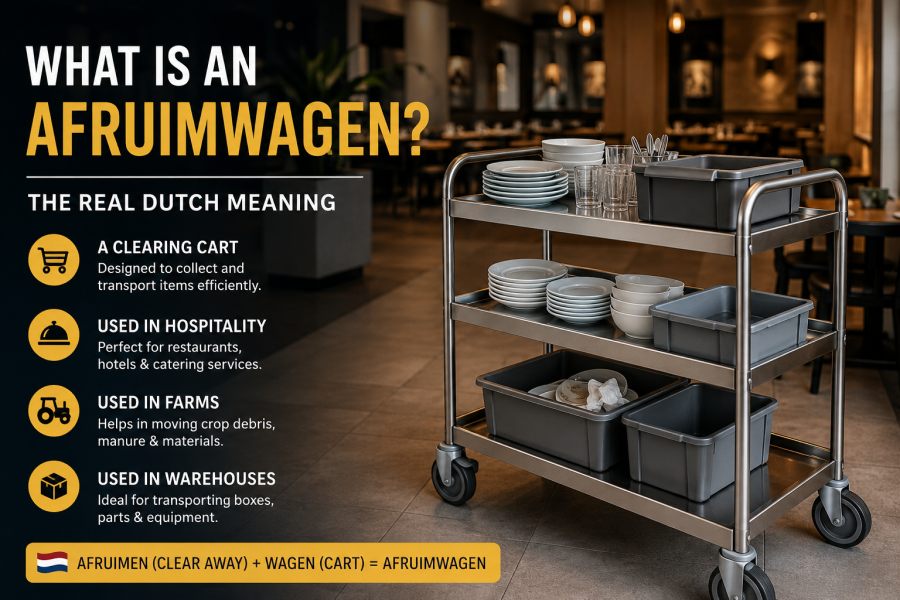
A cart. That’s really the short version. An afruimwagen is Dutch for a clearing cart. It’s a wheeled trolley built to collect dirty dishes, farm debris, or warehouse boxes, whatever needs moving from one spot to another without someone carrying it by hand. The word splits into “afruimen” (clear away) and “wagen” (cart). A couple of sites have recently started calling these things electric vehicles. That has nothing to do with the actual word. Real meaning, real uses, and what to look for if you’re buying one, all below.
Where the Afruimwagen Word Actually Comes From
Nothing complicated here once you look at the real Dutch. “Afruimen” means to clear away or tidy up, confirmed in Van Dale, the leading dictionary of the Dutch language. “Wagen” is cart or wagon, same root that gives English “wagon.” Combine them and you get precisely what the word suggests: a cart whose whole job is clearing things away. Dutch builds plain, functional compounds like this constantly, not far off from how an English speaker would say “bussing cart.”
A handful of unrelated sites land on this exact same breakdown independently, afruimen plus wagen, without obviously copying each other’s phrasing. That’s usually a decent sign the translation holds up. The same pattern shows up in Dutch fashion terms like blazertje, where a base word plus a suffix changes the meaning predictably. A “vuilniswagen” collects garbage. A “brandweerwagen” is a fire truck. Stick almost any action verb onto “wagen” and you get a cart named after what it does. Afruimwagen fits that same mold exactly, descriptive rather than branded, nothing invented about it.
The Fabricated Afruimwagen Electric Vehicle Claim
Here’s where it gets weird. Two sites currently ranking for this term describe afruimwagens as electric mobility vehicles. Something closer to an e-scooter than a cart. “The future of sustainable urban transportation,” one calls it. Another frames it as a straight alternative to gasoline cars, complete with carbon-emissions language and eco-commuting framing.
None of that holds up. Nothing in “afruimen” or “wagen” implies moving people, let alone a battery or a motor. No manufacturer anywhere markets something called an afruimwagen as a personal ride-on vehicle. Search results in actual Dutch-language contexts point the same direction every time: cleaning equipment, material handling. Nothing you’d sit on and drive.
This is a fairly familiar pattern with obscure foreign terms online. Something guesses at a definition from how a word sounds instead of what it translates to. That gets paraphrased across a handful of thin sites chasing the same low-competition keyword. The wrong answer compounds because nobody checks the source. If you’re researching this for a purchase, or just a translation, skip that claim entirely. It’s not real.
What Afruimwagens Are Actually Used For
Set the fake definition aside and the real picture holds together fine. Afruimwagens show up wherever staff need to clear items fast without hauling them by hand. That turns out to be a pretty specific list of places.
Restaurants and hotels are probably the most common setting. A server pushes a cart between tables, loads plates, glasses, and cutlery in one pass instead of three trips. Done. Catering companies and banquet halls run the same basic design, sometimes with extra shelving bolted on for linens or trays. Hospitals aren’t far behind. Soiled linen, used supplies, medical waste, all moved the same way, cart to collection point. Healthcare versions just tend to care more about how easily they sanitize than how much they hold.
Agriculture is probably older than either of those, honestly. Dutch farms have used clearing wagons for generations, gathering crop debris or manure and hauling it across a field. That’s long before anyone thought to put wheels on a restaurant tray rack. The bigger farm versions get pulled by tractors rather than pushed by a person. Some are fitted with hydraulic tipping beds, so a single operator can dump a full load without lifting anything manually. Warehouses and construction sites use the heavy-duty end of the category. Parts, boxes, and debris that’s too much for carrying by hand but not really forklift-sized either. A single worker with one of these can clear a job site corner in a few passes. That beats a dozen trips with an armload each time.
Who Actually Buys and Uses Afruimwagens
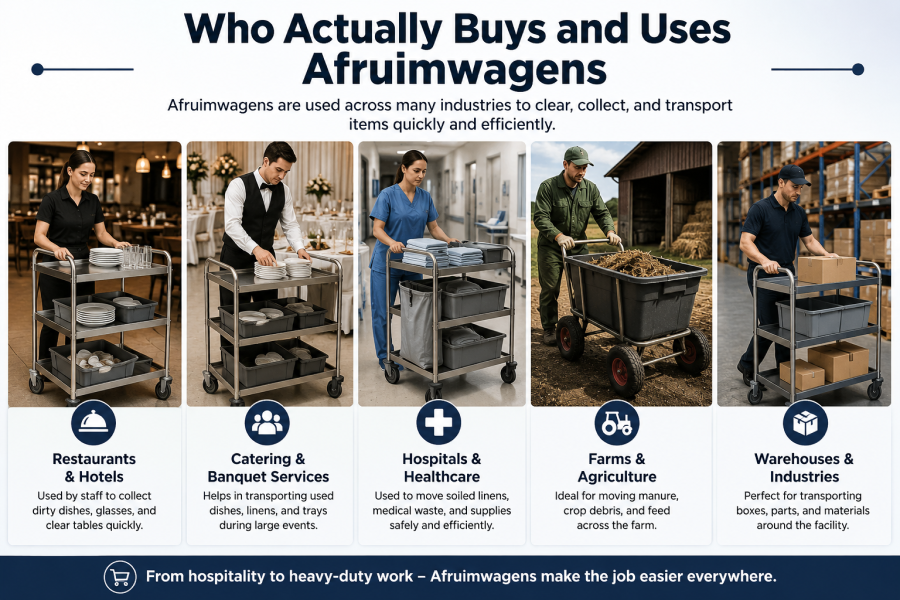
Mostly it comes down to job type rather than company size. Restaurant owners and hotel operations managers are typical buyers on the hospitality side. Usually replacing an older or damaged cart rather than starting from scratch. Facilities managers handle it in hospitals. They often work from a fixed equipment budget that dictates stainless steel over plastic, regardless of price. Farmers buy the agricultural versions directly from equipment dealers, sometimes secondhand. A well-maintained towed wagon can last decades with basic upkeep. Construction and warehouse buyers tend to be procurement staff sourcing in bulk for a whole site rather than one unit at a time. That’s where price per cart starts mattering more than any single feature.
Common Types of Afruimwagens
The shape changes a lot depending on the job. Tiered service carts, two or three open shelves stacked up, are the standard restaurant and hotel version. Built to squeeze down narrow aisles between tables. Flatbed carts drop the shelving entirely for one open platform, better for crates or oddly-shaped debris. Healthcare tends to favor enclosed linen carts, a canvas or plastic cover over the load. Partly hygiene, partly just keeping soiled items out of sight in patient areas. Then agricultural clearing wagons, easily the biggest of the four. Several feet long, towed instead of pushed, reinforced enough to handle wet, heavy loads like manure without the bed giving out.
Afruimwagen vs. a Standard Utility Cart
People ask sometimes whether this is just a fancier name for a generic utility cart. Honestly? The line’s a little fuzzy. Both roll, both move stuff, both exist to save someone’s back.
Where they actually differ is intent more than technical spec. A generic utility cart is built flexible, flat surface, holds whatever you put on it. An afruimwagen usually gets shaped around one specific clearing job from the start. Shelving sized for plates in a restaurant version, a reinforced towed bed sized for crop debris on a farm. The word describes a purpose, not a fixed design. That’s exactly why these things look so different industry to industry while sharing one Dutch name underneath it all.
If a supplier lists something as a plain utility cart versus a purpose-built afruimwagen, that distinction alone tells you something about how specialized the shelving or weight rating will be. It’s the same naming logic covered in our breakdown of what Lufanest actually is: a specific term describing a narrower purpose than the generic category it sits inside.
What Separates a Good Afruimwagen From a Cheap One
Shopping for one? A few things matter more than the rest.
Frame material first. Stainless steel survives constant washing and daily abuse. That matters a lot in restaurant and healthcare settings that hose these things down repeatedly. Reinforced plastic costs less and works fine for lighter, occasional use. It just cracks or warps faster once heavy daily loads start piling up. Wheels come next. Cheap ones are almost always the first thing to fail on a cart used several times a day. Smooth-rolling casters with a working lock or brake make a real difference on ramps and uneven floors. A lot of buyers skip checking this until it’s too late.
Afruimwagen Shelving, Weight Limits, and Load Safety
Shelving depends entirely on the load. Tiers work for dishes and glassware. A flat open bed suits bulkier crates or debris better. Hooks or bins help with smaller loose items that would otherwise slide everywhere. Weight capacity is worth confirming directly with whoever’s selling it, rather than assuming. OSHA’s material handling guidelines recommend keeping push force under roughly 50 pounds. Also, don’t load a cart above eye level, mainly to avoid back strain and blocked sightlines. A cart rated for dish loads in a restaurant won’t necessarily hold up under wet agricultural material. Overloading a lightweight model is a common way carts fail early.
Afruimwagen Maintenance by Material Type
Maintenance matters more than most buyers expect going in. Stainless steel needs almost nothing beyond regular wiping and the occasional wheel lubrication. That’s a big part of why it costs more upfront but ends up cheaper over several years of daily use. Plastic models need less lubrication but tend to show stress cracks around joints and welds sooner. Especially outdoors or in cold storage, where the material gets brittle. Agricultural wagons need the most attention of the group. Mainly hitch points and hydraulic lines, if the model has a tipping bed. Those are the parts most likely to wear or leak with heavy seasonal use.
Frequently Asked Questions About Afruimwagens
What does afruimwagen mean in English?
“Clearing cart,” roughly. From Dutch “afruimen” (clear away) and “wagen” (cart).
Is an afruimwagen an electric vehicle?
No. A couple of sites claim this. It doesn’t match the word’s actual meaning or how it’s used in Dutch. It’s a cart, not something you ride.
Where are afruimwagens used?
Restaurants, hospitals, farms, warehouses, construction sites, basically anywhere staff need to clear or move items without carrying everything by hand.
What material holds up best?
Stainless steel for heavy daily use, especially anywhere hygiene matters. Reinforced plastic is fine for lighter or occasional jobs and usually costs less.
Is this an obscure word in Dutch, or something people actually say?
Pretty ordinary, actually. Dutch forms these action-plus-wagen compounds constantly, so it reads as plainly descriptive to a native speaker, not as jargon.
What’s a typical price range?
Varies a lot by size and material. Small plastic service carts sit at the cheap end, large stainless steel or agricultural models cost considerably more.
Bottom Line on Afruimwagens
A Dutch clearing cart. That’s genuinely all it is. The word breaks down cleanly into “clear away” plus “cart.” That’s exactly the job it does across restaurants, hospitals, farms, and warehouses. The electric vehicle claim floating around a couple of thin sites doesn’t survive contact with the actual etymology. Or with any real product on the market, for that matter. Buying one? Frame material and wheel quality first, since those two things decide how long the cart actually survives daily use. Shelving style, capacity, extra features, all secondary once those fundamentals are locked down.