

Quick Answer: Quantum Computing Breakthroughs From 2024 to 2026
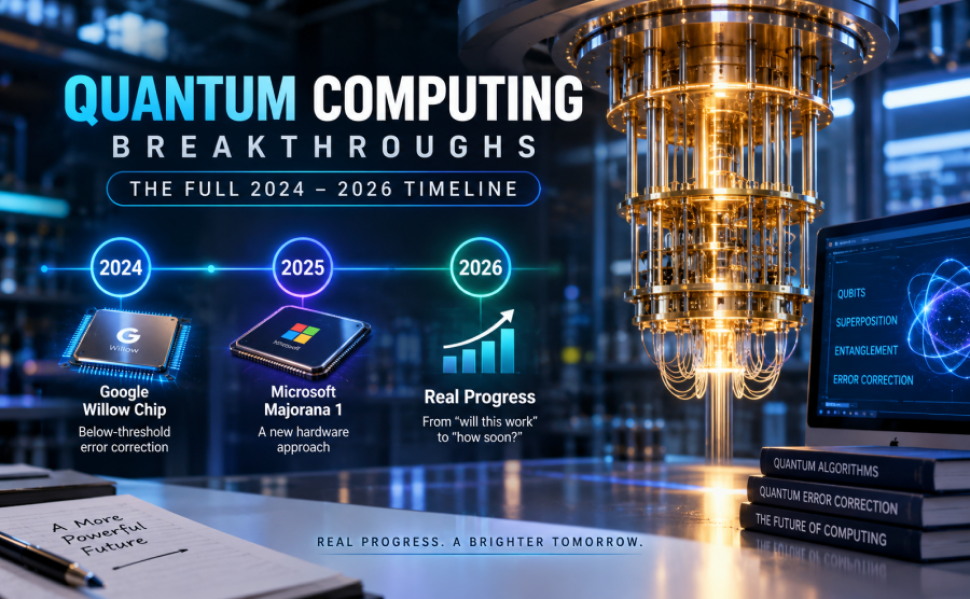
The last two years have delivered some of the most important quantum computing breakthroughs in the field’s history. It wasn’t one dramatic headline moment – it was more like a field slowly crawling out of “interesting physics” and into “this actually works.” Google’s Willow chip kicked things off in December 2024. For the first time, piling on more qubits made errors go down instead of up. Microsoft fired back a few months later with Majorana 1, staking its bet on a completely different hardware approach. Then, late in 2025, Google ran an algorithm fast enough – and verifiable enough – that even die-hard skeptics struggled to shrug it off. By 2026, the question everyone asked had quietly flipped, going from “will this work” to “how soon.” If you’re new to the topic, our beginner’s guide to how quantum computers work is a good place to start before diving into the timeline below. Here’s the full rundown, roughly in order.
What Is a Qubit, in Plain Terms
Feel free to skip this if you already know the basics. A classical computer bit is either a 0 or a 1 – nothing sits in between, ever. A qubit works differently. It can sit at 0, at 1, or in a blend of both at once. We call that superposition. Qubits can also entangle with each other: measuring one instantly tells you something about another, even without any physical connection between them. Put those two properties together and you get real theoretical power on certain problems. But you also get qubits that are almost absurdly sensitive to outside interference – vibration, heat, stray electromagnetic noise can all knock a qubit out of its fragile state. That fragility is basically why error correction became the central challenge behind so many recent quantum computing breakthroughs.
One more distinction matters here: physical qubit versus logical qubit. A physical qubit is a single real unit of hardware – an atom, a superconducting loop, whatever the platform uses. A logical qubit is a cluster of physical qubits working in tandem, with enough redundancy built in that the group can catch and fix errors no single qubit could survive alone. For a deeper technical dive, see our guide to quantum error correction. Honestly, most of what follows is really just progress on that ratio – researchers keep squeezing more reliable logical qubits out of fewer physical ones.
Why 2024 Was the Turning Point for Quantum Computing Breakthroughs
Noise. That’s the one-word explanation for why quantum computing stalled for decades. Every qubit added to a real processor drags its own errors along with it. For most of the field’s history, more qubits simply meant more noise stacked on more noise – and not in some gentle, manageable way. Researchers kept watching systems become harder to control as they scaled up, which is roughly the opposite of what you’d want from a technology meant to grow.
The field had a specific term for the fix everyone chased: below-threshold error correction – the point where scaling a system up actually lowers the error rate instead of raising it. Nobody had managed it on real hardware. Then, in December 2024, Google Quantum AI said its Willow chip had finally pulled it off, setting the stage for the wave of quantum computing breakthroughs that followed.
Google’s Willow Chip and the 2024 Breakthrough
Willow packs 105 superconducting qubits. Honestly, the qubit count wasn’t really the headline — the direction the error rate moved is what mattered. As Google scaled up the surface-code lattice on the chip, errors dropped instead of climbing. That’s the below-threshold result physicists had spent years chasing, and it reset the field’s entire roadmap. A vague “someday” suddenly looked like an actual plan. You can read Google’s own account of the milestone in the Willow processor overview on Wikipedia.
A benchmark came attached too: random circuit sampling. Willow finished in minutes what today’s fastest classical supercomputers would need an almost unreasonable stretch of time to complete. Skeptics had a fair point at the time — benchmarks like this don’t automatically translate into anything useful. The field answered that criticism about a year later.
Other 2024 Milestones Worth Knowing
Willow wasn’t the only notable result that year. Microsoft and Quantinuum managed an 800-fold drop in error rates on trapped-ion hardware back in April. They turned 30 shaky physical qubits into four genuinely stable logical ones through something called qubit virtualization. A few months later, Microsoft teamed up with Atom Computing to entangle 24 logical qubits on a neutral-atom system. These were individual atoms held in place and steered by precise lasers.
IBM and Moderna, an odd pairing on paper, ran quantum simulations of mRNA structures. They hit a field record with 80 qubits modeling sequences of 60 nucleotides. It wasn’t anywhere near a finished drug pipeline. Still, it proved quantum hardware could reach into actual biology instead of staying stuck on physics-only demos. Separately, a Quantinuum team working with Harvard and Caltech researchers reported an early experimental version of a topological qubit. This design could eventually need far fewer physical qubits to build one reliable logical one.
Microsoft’s Majorana 1 and the 2025 Shift in Quantum Computing Breakthroughs
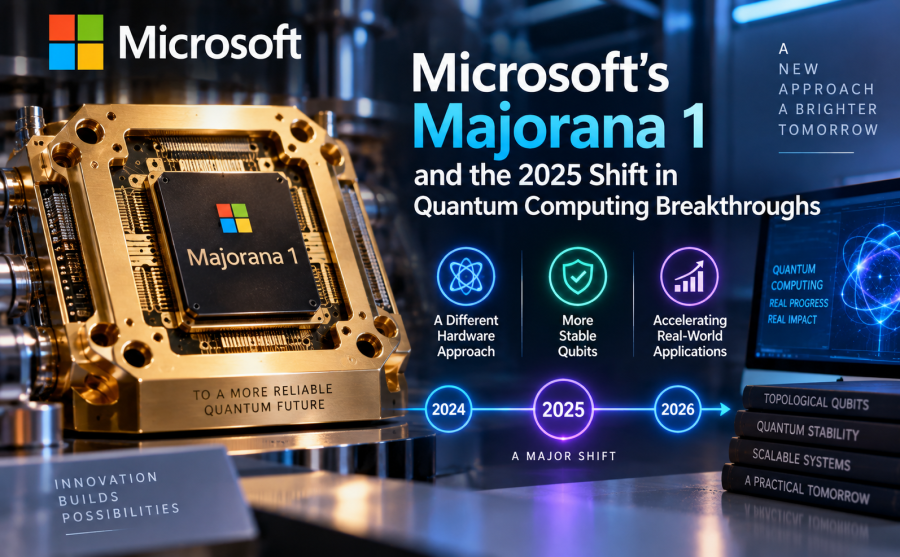
2024 proved error correction could actually work. February 2025 asked a different question entirely: what if the hardware itself had been built wrong from the start? Microsoft answered with Majorana 1, the first processor built around topological qubits — a bet most of the industry hadn’t made, since it had already committed to superconducting or trapped-ion designs.
Coverage of this chip got hyped well past what Microsoft actually demonstrated, so it’s worth being precise. Majorana 1 currently runs eight qubits, not the million the roadmap talks about — that million-qubit figure is a stated target for the architecture, not something shipped. Real scientific pushback exists too. A Nature peer-review editorial note attached to Microsoft’s paper flagged open questions, and physicist Henry Legg published a public critique in 2026 questioning whether the devices genuinely host the Majorana zero modes the whole approach depends on. None of that makes the effort fake, but it’s a good reason to treat any single vendor’s announcement, however well-funded, with the same skepticism you’d apply to any other unverified research claim.
How Topological Qubits Fit Into the Bigger Picture
The theory behind topological qubits holds that they resist noise more naturally, since the information doesn’t sit in one fragile physical state the way a conventional qubit’s does. Microsoft went big with the pitch — a design theoretically scalable to a million qubits on a single chip. That number sits nowhere close to reality yet, but the underlying bet was serious: maybe a fundamentally different physical approach reaches fault tolerance faster than grinding out error correction on hardware everyone already knew had limits.
Research output jumped hard that year too — something like 120 quantum error correction papers came out in the first ten months of 2025, against just 36 for all of 2024. Willow had clearly pulled a lot of attention toward the same problem, fast. February also brought the first working demo of distributed quantum computing over a photonic network, linking separate processors together instead of just cramming more qubits onto one chip.
Google’s Quantum Echoes Algorithm Verifies Quantum Advantage (Late 2025)
Remember that benchmark criticism from 2024? October 2025 answered it head-on. Google’s Quantum Echoes algorithm ran roughly 13,000 times faster on Willow than the best classical supercomputers could manage — and this time, independent researchers could actually check the result themselves.
That verification piece is really the story here, more than the speed number. Earlier quantum demos had a habit of picking tasks tilted to favor quantum hardware, with no solid way for outsiders to confirm the win wasn’t baked into the setup from the start. Quantum Echoes broke that pattern. Researchers are pitching it as a tool for probing the structure of complex systems — molecules, magnetic materials, that kind of thing. A related experiment even used it to measure molecular geometry through quantum-enhanced nuclear magnetic resonance data.
What’s Happened in 2026 So Far
A Science paper published in January 2026 compared the field’s current moment to classical computing right before the transistor took over everything — a shift from isolated lab curiosities to hardware quietly showing up in practical settings.
The rest of the year mostly backed that comparison up. Willow demonstrated exponential error suppression at hardware scale: logical error rates dropped by a factor of roughly 2.14 each time the surface-code lattice got bigger, giving the field its first real hardware proof that fault-tolerant scaling behaves the way theorists predicted on paper. Then August brought something different — OTI Lumionics and Samsung’s Advanced Institute of Technology emulated over 200 logical qubits on a single server, running an algorithm built for OLED materials design. That’s a commercial use case, not just another physics flex.
A few other threads moved forward as well. One team built chip-based quantum memory using nanoprinted structures that trap light inside atomic vapor, aiming for faster, more reliable storage of quantum information. Another team extended the usable lifetime of magnons — tiny magnetic waves once written off as too short-lived to matter — by nearly a hundredfold, opening the door to quantum computers built at a much smaller physical scale. In September, Rigetti and Purdue demonstrated a quantum preconditioning framework meant to speed up classical solvers on constrained optimization problems — one more entry in the hybrid quantum-classical approach the industry now treats as its default near-term playbook.
From Physics Experiments to a Service Model
The hardware wasn’t the only thing that changed shape between 2024 and 2026 — how the industry actually uses this stuff shifted just as much. Enterprises started wanting cloud access to quantum hardware without owning or babysitting it themselves, a model people now call quantum-as-a-service. Hybrid quantum-classical setups became the default: a quantum processor handles one narrow bottleneck inside an otherwise classical pipeline, rather than trying to replace the whole thing. If your team is evaluating providers, see our comparison of quantum-as-a-service platforms.
Governments moved too, on a parallel track. National quantum strategies and funding kept expanding through 2025 into 2026, alongside a genuinely serious push on post-quantum cryptography — getting encryption ready for a future where a strong enough quantum computer could theoretically crack much of what secures the internet today. That future isn’t here yet, but almost nobody left in the field still treats it as some far-off hypothetical anymore. For more on that risk, read our explainer on post-quantum cryptography.
Frequently Asked Questions About Quantum Computing Breakthroughs
What was the biggest quantum computing breakthrough of 2024?
Google’s Willow chip, announced that December. It became the first processor to demonstrate below-threshold error correction – errors actually dropped as more qubits got added, rather than piling up.
What is Microsoft’s Majorana 1 chip?
A processor Microsoft unveiled in February 2025. It runs on topological qubits instead of the superconducting or trapped-ion approaches most competitors use. The current chip runs eight qubits, with a roadmap target of a million qubits on one chip. Some physicists have publicly questioned whether Microsoft’s devices actually demonstrate the Majorana zero modes the design depends on.
Has quantum advantage actually been verified?
Yes. In October 2025, Google’s Quantum Echoes algorithm ran about 13,000 times faster than classical supercomputers on Willow. Independent researchers verified it themselves, rather than just trusting a benchmark designed to favor quantum hardware.
What does quantum error correction actually mean?
It means combining several unreliable physical qubits into a smaller set of sturdier logical qubits. Built-in redundancy lets the group catch and fix errors on the fly without disturbing the fragile quantum state being read.
Is quantum computing ready for real-world use in 2026?
Sort of. Companies already deploy hybrid systems commercially for narrow problems like materials design and optimization. Full-scale, general-purpose fault-tolerant quantum computers remain a ways off.
Should I be worried about quantum computers breaking encryption?
Not right now. No existing quantum computer can crack standard encryption. Google itself has said its own hardware remains at least a decade away from threatening something like RSA encryption. Even so, the possibility has already pushed serious investment into post-quantum cryptography, well ahead of when it might actually become a practical threat.
Bottom Line on Quantum Computing’s 2024–2026 Run
Taken together, these quantum computing breakthroughs mark a real inflection point: the field spent decades proving the physics could work, and it’s now proving the engineering can scale. Below-threshold error correction, a working (if early) topological qubit platform, and a verifiable quantum advantage all landed within about 22 months of each other. None of it means general-purpose quantum computers are here – but the gap between “interesting experiment” and “useful tool” is closing faster than most people expected even in 2024.