

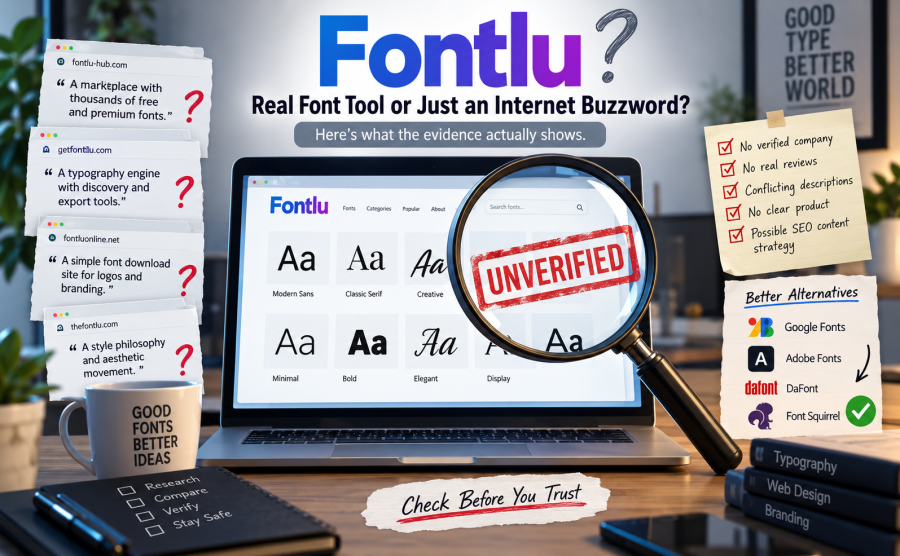
Quick answer: No, not in any way that holds up. “Fontlu” is a name popping up on a handful of newly built websites. Each one describes it as something different – sometimes flatly contradicting the last. There’s no single company behind it. There’s no consistent product either. And nobody on Reddit or in any design community seems to have actually used the thing. What follows is a rundown of what’s actually out there under that name, and why it behaves so strangely.
What People Mean When They Search “Fontlu”
Most people typing “fontlu” into Google want one of three answers. Is it a font tool worth trying? Is it safe? Or what does the word even mean in the first place? That last question ends up mattering most, because the answer shifts depending on which page you click.
Here’s the thing – a few recently published pages use the exact same name to describe things that have almost nothing in common. One calls it a font marketplace boasting “thousands of free and premium fonts.” Another pitches it as a “typography engine” that bundles discovery, preview, and export into one workspace. A third treats it as a plain font-download site for logo and branding work. And then there’s the one that goes a completely different direction, describing Fontlu as a “style philosophy and aesthetic movement” – which isn’t software at all.
That last one doesn’t line up with the first three. Not even close. A real product, no matter how small, usually has one identity: a single website, a defined set of features, some kind of story about who made it and why. Fontlu just doesn’t have that. What it has instead are several disconnected stories, published around the same time, on domains with no history to speak of.
Why the Definitions Don’t Agree
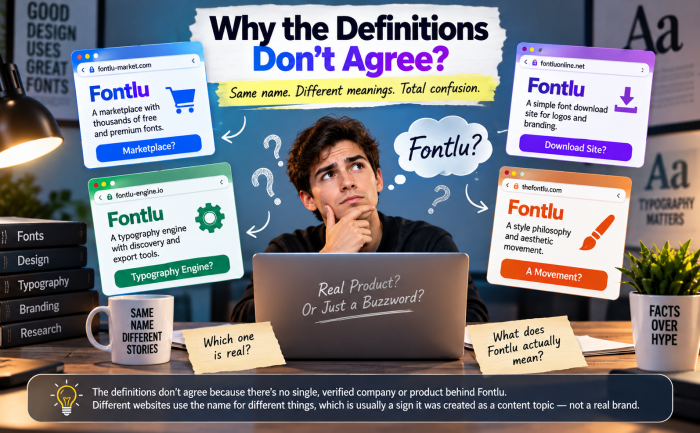
And this, honestly, is the part that matters most. When several unrelated websites use the same brand name to describe entirely different products, that’s not what a growing platform looks like. It’s usually a sign the name was picked as a content topic first. A real company, if one ever existed, came second.
One of the sites using the term actually admits as much itself. It says outright that “fontlu” isn’t tied to one single, verified platform with a consistent track record. Different sources describe it differently, it adds, simply because there’s no agreed-upon definition yet. For a page supposedly explaining what Fontlu is, that’s a strangely candid thing to say. And it fits everything else pointing the same direction.
A few other signals back this up. The hosting, for one, is disposable. Some of these domains sit on free subdomains meant for quick test projects, not the kind of infrastructure a real, customer-facing tool would run on. There’s also no changelog anywhere, no pricing page, no app, and no support contact. Every actual SaaS product has at least one of those, even the tiny ones. Fontlu, across every version of it, has none.
Then there’s the silence. Search Reddit, design forums, typography subreddits – nothing turns up. No reviews, no complaints, not even a “has anyone tried this” thread. Real tools, even obscure ones, tend to generate some chatter over time. This one’s generated exactly zero. On top of that, the writing across all these “different” descriptions sounds like the same person wrote it. Same sentence rhythm. Same breathless adjectives – “revolutionary,” “ultimate,” “ecosystem” – despite supposedly coming from unrelated creators.
Put it together and it lines up with something fairly common in low-quality SEO content. Someone invents or repurposes a name, seeds it across a batch of new sites with AI-written articles, and hopes to catch search traffic before anyone checks whether the “product” is even real.
Is There an Actual Website Called Fontlu?
A few domains are currently running content under the Fontlu name, sure. But none of them look like an established, actively maintained product. There’s no verifiable company anywhere. The feature set changes from site to site. And there’s no real way to confirm a working font library sits behind any of the marketing copy. If you land on one of these pages hoping for an actual font-discovery tool, treat it the way you’d treat any unfamiliar site. Skip the account creation. Don’t hand over payment info. And don’t download anything until you can verify who’s actually running it.
None of this proves bad intent, to be fair. A lot of content built this way is just low-effort SEO filler, not an active scam. Still, “not a scam” and “an actual usable product” aren’t the same claim. Right now, nothing here clears the bar for the second one.
What “Fontlu”-Style Content Usually Looks Like
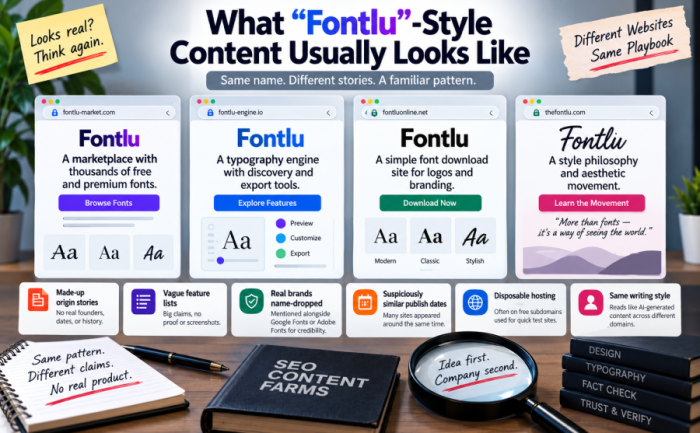
If you’ve already scrolled through a few of these Fontlu pages and thought they sounded oddly alike, you weren’t imagining it. There’s a pattern, and once you see it, you can’t unsee it. Made-up origin stories show up a lot – lines like “the creators of Fontlu envisioned…” with no name, date, or founding detail attached anywhere. Feature lists tend to describe an idea rather than a product. “Real-time previews,” “smart filtering,” “collaboration tools” – all mentioned in the abstract, never once backed by a screenshot or a working link. Real brands get name-dropped too, mostly to borrow their credibility. Sitting Fontlu next to Google Fonts or Adobe Fonts implies it belongs in that company, without ever proving it does. And the publish dates across these unrelated domains cluster suspiciously close together, which usually means the same content brief got sent out to seed several sites at once.
It’s the same playbook behind a long list of other manufactured “tool” or “brand” names that make the rounds through low-quality content farms every year.
If You Actually Need a Font Tool
If what you were really after is just a legitimate way to browse and preview fonts, skip the guesswork. Google Fonts is free, open-source, and used all over the web, with licensing that’s easy to understand. Adobe Fonts comes bundled with Creative Cloud and throws in decent pairing suggestions plus proper commercial licensing. DaFont has been around forever and is free for personal use – just check the license before selling anything commercially. Font Squirrel offers fonts already cleared for commercial use, plus its own webfont generator. And if you need something more premium, MyFonts or Fontspring are the usual go-to marketplaces for licensing typefaces the right way.
Every name on that list has a real company behind it, a support line you can actually reach, and a history you can verify yourself. None of that is true, so far, of anything published under the Fontlu name.
Common Misconceptions About Fontlu
A lot of people assume Fontlu must be some new competitor to Google Fonts. There’s just no evidence for that. Nothing published under the name shows an actual working product, and no independent source backs it up either. It fits the same pattern we broke down in our Levapioli fact-check – a name manufactured for search traffic rather than adopted by a real brand.
Others jump straight to “it’s definitely a scam,” which is a bit of a stretch too. Calling it that overstates what’s actually going on. What we’ve got is an unverified name attached to inconsistent, low-effort content, and that’s a different problem than someone actively trying to take your money.
There’s also this idea that if several sites mention something, it must be real. Not really, though. Repetition alone doesn’t confirm anything, especially once you notice those sites can’t even agree on what the name refers to. We’ve seen the exact same setup with Zavalio and TVLIO – different domains, same manufactured-name playbook.
FAQs
Is Fontlu a real font website?
Not one you can point to with confidence. There’s no evidence of a single, consistent platform called Fontlu backed by an established company or track record. Different sites use the name for completely different things.
Is Fontlu safe to use?
Best to be cautious. There’s no confirmed, consistent product behind the name. Hold off on entering payment info or downloading anything until you’ve verified who’s actually running the site.
Why do different websites describe Fontlu so differently?
Most likely because it’s functioning as a generated content topic rather than a brand anyone actually built. A real product doesn’t end up with several unrelated, contradictory identities across different sites.
Is there a company behind Fontlu?
Nothing shows up — no founders, no headquarters, no registration details, no history, nowhere.
What should I use instead of Fontlu for finding fonts?
Google Fonts, Adobe Fonts, DaFont, and Font Squirrel all work fine. Each comes with clear licensing and real support behind it.
The Bottom Line:
“Fontlu” isn’t something you can point to with real confidence. It’s a name floating across a small cluster of newly published sites, each one describing something different under the same label. The mismatch, plus the total absence of independent discussion or a working product, is basically the whole story here. Want a font tool that’ll still be around next year? Stick with the names above instead.