

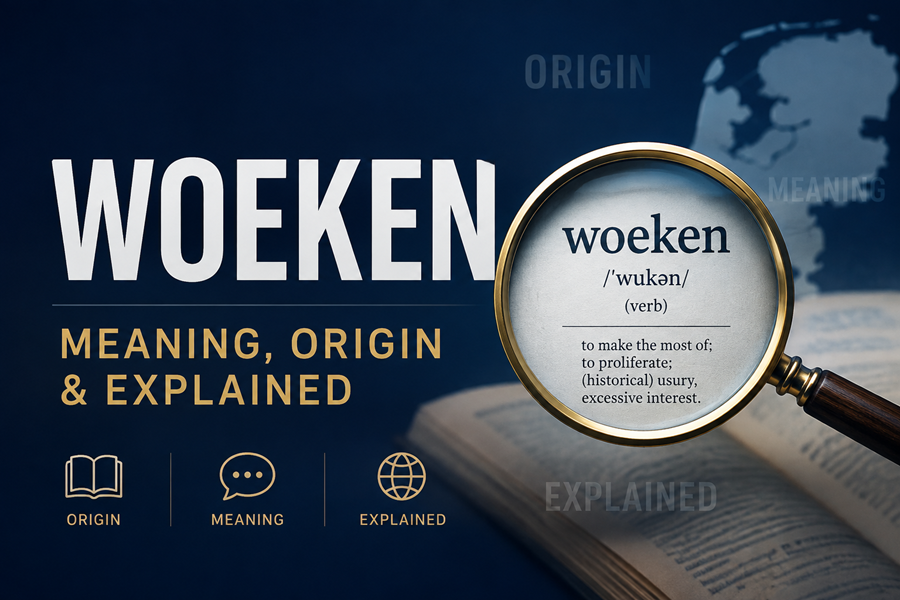
Woeken is a surprisingly difficult word to define because different websites currently offer completely different explanations of what it means. Some pages confidently describe it as a new platform, technology, slang term, or emerging online concept, while others connect it to entirely different ideas. The problem is that many of these explanations provide little or no reliable evidence to support their claims. As a result, finding the actual meaning of woeken requires looking beyond repeated online statements and checking where the word may have originally come from.
Why Is Woeken So Difficult to Define?
The situation becomes even more interesting when you look at its possible Dutch connection. Rather than being a clearly established English word, woeken appears to have a relationship with the Dutch verb woekeren, which has an older meaning connected to usury and a more modern sense related to making full use of something, such as one’s talents. However, not every claim about the word’s modern usage can be verified, so it’s important to separate dictionary-supported information from internet speculation.
In this article, we’ll explore the meaning of woeken, its possible origin, how its meaning developed, why the term appears to be gaining attention online, and which claims about it should be treated cautiously. We’ll also look at the difference between genuine linguistic evidence and definitions that may simply have been repeated from one website to another. By the end, you’ll have a clearer picture of what woeken actually refers to-and, just as importantly, what we still don’t know for certain.
What Does Woeken Actually Mean?
No major English dictionary lists it as a standard word – I checked. And I couldn’t find any publicly verified company or brand that’s officially trademarked it either. So if you clicked on an article that told you, with total confidence, that woeken is “a revolutionary new platform” or “the next big thing in tech,” treat that with real suspicion. As far as I can tell, nobody making that claim has shown any actual evidence for it.
What does check out, according to Dutch-language dictionaries and Wiktionary, is the word’s likely origin. It looks like a shortened form of the Dutch verb woekeren, and the timing and spelling make that a reasonable connection. Woekeren comes from the Middle Dutch noun woeker, and its original, dictionary-confirmed meaning is blunt: usury. Lending money at excessive, exploitative interest. Think of an old-world moneylender bleeding a desperate borrower dry, and you’ve got the right picture.
Trimming the “-eren” off the end isn’t strange, by the way. Flemish and other regional Dutch dialects drop verb endings constantly in everyday speech, so this shorter form fits a known pattern rather than being some random internet mutation.
The Woeken Origin Story Has a Twist
Here’s the part that actually made me pause while researching this. Modern Dutch didn’t leave woekeren stuck in its old, ugly meaning. Dutch dictionaries also list a second, much friendlier sense – “to make the most of” or “to proliferate” – and it shows up in the everyday phrase “woekeren met je talenten,” roughly “make full use of your talents.” No exploitation, no predatory lending. It’s closer to how English speakers say “leverage your strengths.”
That’s a wild journey for one word – from squeezing desperate borrowers to motivating someone at a career fair. But this kind of drift happens more than you’d think. English does it too. “Leverage” started life as a term about physics and levers, wandered into finance, and now shows up in every other LinkedIn post about personal growth. Words move around, and this one just happens to be doing its moving in Dutch, while something else entirely is happening to it in English search engines.
Why Is Everyone Searching Woeken Right Now?
This is where it gets messier, honestly, because there isn’t one clean cause – and I want to be upfront that not everything below is equally solid. Some of it I could confirm. Some of it, I could only find in a single place online, which is worth flagging rather than hiding.
The first explanation is the one I trust most: a feedback loop. A few low-effort websites started guessing at a definition, probably because they noticed the search volume ticking up and wanted a slice of that traffic. Those guesses generated curiosity. That curiosity generated more searches.
More searches convinced more sites to publish more guesses. Round and round it goes. This happens with obscure or newly-surfaced terms more often than you’d expect, and it’s the most straightforward reason a word with no real meaning can still spike in search volume.
The second explanation is one I’d treat with caution. One article claims there’s a motorcycle-focused content creator online using the handle @woe_ken. I looked for independent confirmation of this – other mentions, a following, anything — and came up empty. It might be true. It might just be one site’s guess. Until it shows up somewhere else, I’d file it as unconfirmed rather than fact.
Third, a couple of sites describe “woeken” being used casually as slang for deep, distraction-free focus — something like “I’m going to woeken through this deadline.” Same caveat applies here: I only found this claim in one place, with no examples of it actually being used that way in the wild.
It’s plausible — this is exactly the kind of shorthand that pops up in productivity-minded online spaces — but plausible isn’t the same as confirmed.
And fourth – plain and simple – some people are just misreading “woken.” It happens. There’s no confirmed connection between the two words, even though they look similar on a page.
None of these four explanations cancel each other out. They’re just different corners of the internet colliding around the same unusual string of letters, for reasons that don’t overlap much at all.
How to Spot a Fake Definition
While I was digging through this, I noticed something worth flagging, because it’ll save you time next time you’re chasing down any obscure word online, not just this one. Most of the fake-sounding articles about it follow the same script: open with a bold claim, sprinkle in vague words like “emerging” or “gaining traction,” and never link to an actual source. No company registration, no interview, no dictionary entry, nothing you could go verify yourself.
That’s usually the tell. Real definitions point somewhere – a dictionary, a linguist’s writeup, a verified brand’s own website, an actual example of the word being used in context. When a page just states something and moves on without evidence, there’s often nothing behind it. A decent habit here: ask yourself if you could confirm the claim in five minutes. If not, treat it as a guess, no matter how confident the writing sounds.
So What Should You Actually Take From This?
If someone asks you point-blank what woeken means, here’s the honest version: its most defensible root is a Dutch verb for usury that later softened into a phrase about making full use of your talents. Beyond that, the picture gets fuzzier – a possible social media handle, possible productivity slang, both resting on thinner evidence, and a search trend that’s largely feeding itself.
Not a tidy one-liner, I know. But it’s accurate, and accurate beats tidy most days – especially when half the internet is currently making things up with a completely straight face.
Woeken FAQs
Is woeken a real English word?
No. It’s absent from every major English dictionary. Its closest real ancestor is the Dutch verb woekeren.
What does woekeren mean in Dutch?
Originally, lending money at excessive interest – usury. Modern Dutch also uses it in “woekeren met je talenten,” meaning to make full use of your talents.
Is there a company or app called Woeken?
Not that I’ve found verified anywhere public. Be wary of any article claiming otherwise without a source attached.
Is there someone behind an @woe_ken account?
One article makes that claim, describing a motorcycle-focused content creator. I couldn’t find it confirmed anywhere else, so treat it as unverified rather than fact until better evidence turns up.
Is woeken just a typo for “woken”?
Possibly, in some cases, but there’s no confirmed link between the two — don’t take that as fact either.