

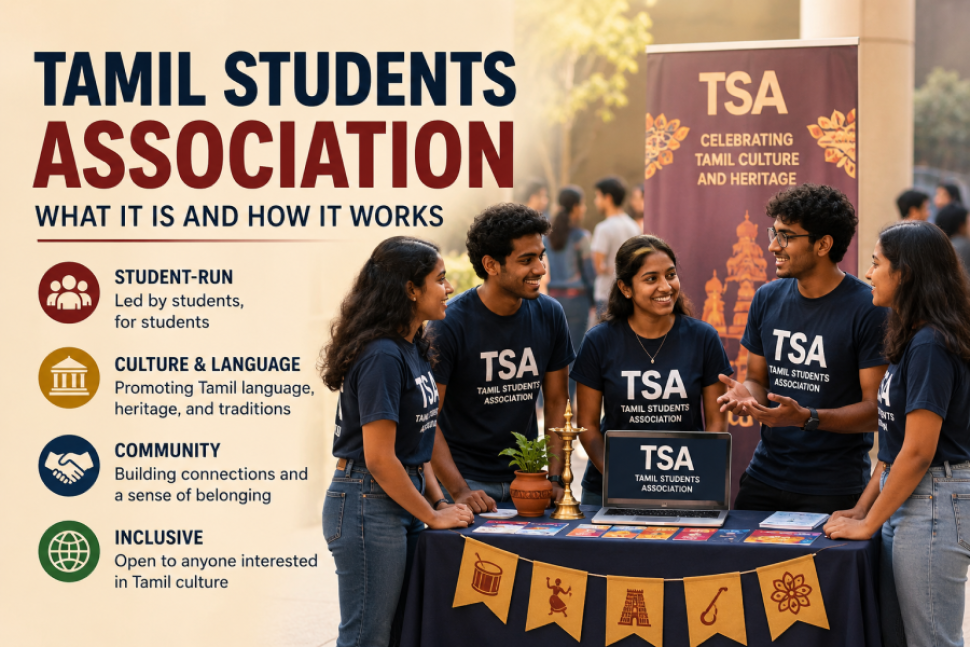
A Tamil Students Association is a student-run club at a university that connects Tamil and Tamil-heritage students and promotes Tamil language and culture on campus. People call it TSA for short. It isn’t one organization. Hundreds of separate clubs at universities around the world use this same name, each one running independently on its own campus with its own students in charge.
That’s the part most people get wrong first. They assume TSA refers to a single group somewhere with branches everywhere. It doesn’t work that way. Toronto has a TSA. Buffalo has one. McGill, UBC, Western, Michigan, Deakin in Australia, dozens more. All separate. All sharing a similar name and rough mission, none of them formally connected.
What a Tamil Students Association Does Day to Day
Looking at how these groups describe themselves across different campuses, the pattern holds pretty steady. Festivals take up a big chunk of the yearly calendar, Pongal, Deepavali, food events, dance performances, music nights. Most also run some kind of language and heritage programming. It’s a way for students who grew up outside Tamil-speaking households to connect with the language, alongside students who already grew up immersed in it.
Community matters here as much as the events do. A lot of these clubs state it directly in their mission, helping students find some sense of belonging when they feel far from home. First-years and international students especially. Some of the bigger, more established chapters have grown past just cultural programming into mentoring, networking, and leadership development, layered on top of the festivals and performances that stay the most visible part of what they do.
Almost none of them restrict membership to Tamil students only. Most explicitly say anyone curious about the culture is welcome, no background requirement attached.
A Few Real Tamil Students Association Examples
Toronto’s St. George campus TSA describes itself, on the university’s official student organization portal, as a space celebrating Tamil culture, heritage, and identity, while also supporting academic, social, and professional growth. UBC’s version in Canada centers on cultural festivals, dance, music, and language classes, plus community service and work with other student groups on campus. Deakin’s DTSA in Australia calls itself a home for Tamil speakers and heritage students specifically. Also open to anyone simply curious about the language, food, and arts. Buffalo’s chapter, meanwhile, focuses on representing Tamil students on campus while creating space for people far from home.
Past these four, chapters run at McGill, Western, Michigan, UMass Amherst, Lancashire in the UK, and Canadian schools including Guelph, Waterloo, McMaster, Carleton, Windsor, Ottawa. Same story nearly everywhere. Independent. Student-run. Similar goal. No formal link between any of them.
How a TSA Differs From a Tamil Sangam
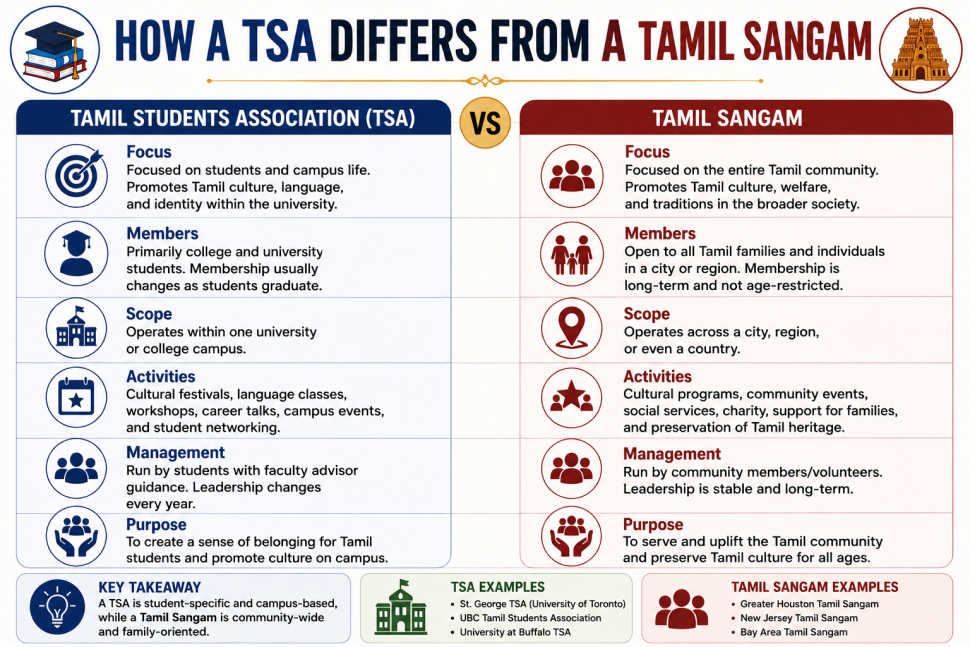
These two get mixed up a lot, so let’s separate them properly. A Tamil Sangam usually serves the whole community, not just students. It typically covers Tamil families across an entire city or region rather than one campus. The Federation of Tamil Sangams of North America lists members like the Greater Houston Tamil Sangam and New Jersey Tamil Sangam, dozens of them, each built around a broader local population rather than a student body.
The word “Sangam” actually carries real history behind it too. It traces back to legendary gatherings of Tamil poets and scholars from ancient times, long before it became a common name for modern community groups. A TSA stays narrower by comparison, tied specifically to current students at one school, with membership naturally cycling out as people graduate every few years.
Put simply: Sangams run broader and more permanent, built around families. TSAs run narrower and student-specific, tied to one campus at a time. Plenty of people move between both.
A Different Kind of Organization Worth Knowing About
There’s one more thing worth clarifying here. Some groups with “Tamil” and “students” in their name are political organizations rather than cultural clubs. The Students Federation for Freedom of Tamil Eelam is one example, a student political federation based in Tamil Nadu, India. It’s connected to advocacy around Tamil Eelam and past protest movements. That’s a completely different type of organization from the campus cultural clubs covered above, and knowing the distinction helps avoid mixing them up if the name comes up somewhere.
Finding a Tamil Students Association at Your School
Most university TSAs list themselves through the school’s official student club portal, findable by searching the club name alongside the university. Instagram tends to work well too, since a lot of chapters run their event updates and contact info through it. Often the handle sits right up top as the easiest way to reach out. If nothing comes up in a search at all, the university’s international, South Asian, or multicultural student office is worth a check, since smaller or newer clubs don’t always show up well online.
Starting a Tamil Students Association If Your School Doesn’t Have One
The process usually matches whatever your school requires for any new student club. A minimum number of interested members. A faculty advisor willing to sign on. Some kind of constitution or mission statement submitted for approval. Reaching out to an existing TSA at a nearby school for advice is common practice too, most chapters are glad to walk someone through how theirs got off the ground.
Frequently Asked Questions
Is there one official Tamil Students Association?
No. It’s a name used independently by student clubs at many universities, each one self-governed with no shared parent organization behind them.
Who’s actually allowed to join?
Almost every chapter stays open to any student interested in the culture, not just students with Tamil heritage. Curiosity’s usually the only requirement.
What actually separates a TSA from a Tamil Sangam?
A TSA stays campus-based, limited to current students at one school. A Sangam runs broader, usually serving Tamil families across an entire city or region instead.
Do these exist outside North America?
Yes. Deakin and other schools in Australia, UK universities like Lancashire and Southampton, plus chapters spread across the US and Canada.
How do I start one if my school doesn’t have it yet?
Follow the standard student club process at your school, interested members, a faculty advisor, an approved constitution. Reaching out to an existing TSA elsewhere for tips helps too.
Bottom Line
A Tamil Students Association isn’t a single organization. It’s a name used by independent, student-run cultural clubs at universities everywhere, each one focused on Tamil language, culture, and community for students on that particular campus. Different from a Tamil Sangam, which serves broader community populations, and different too from unrelated groups sharing a similar name that operate as political organizations instead. Looking to join or start one? A university’s student club directory or student affairs office is the right place to start looking.
Names that get confused for something bigger than they actually are come up more often than you’d think. Our piece on Lufanest digs into a different word with a similarly murky reputation, sorting out what’s actually documented from what’s just been repeated online.