

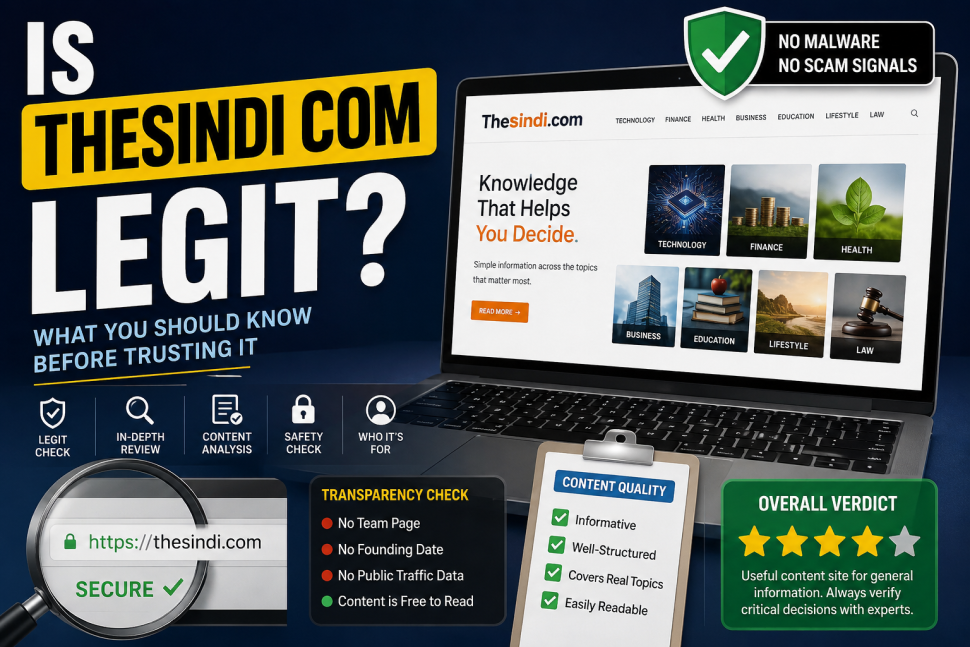
You ran into Thesindi com somewhere, an article link, a search result, maybe a name a friend mentioned. Now two questions sit in your head. What actually is this site? Can you trust what it publishes? Fair questions. Most reviews of this domain answer with vague reassurance instead of a straight look. This guide gives you the straight look. Including one specific finding, a real domain-confusion issue, that nobody else covering this keyword seems to have caught.
Quick version first: Thesindi com is a multi-niche content site. It covers technology, finance, health, business, education, lifestyle, and law. It’s a general-interest publication, not a bank, not a government site, not a store. Whether it deserves your trust comes down less to the domain name. It comes down to how you’d judge any content site, article by article, not as one big verdict.
Thesindi com: The Short Answer
It runs like a standard publishing platform spread across several broad categories. Nothing I found ties it to phishing or malware. What’s genuinely murky is who’s actually behind it. No team page, no founding date, no traffic numbers anywhere public. Reading seems free. You don’t need an account for it.
So What Is Thesindi com, Really?
The site splits its content into around seven categories: technology, finance, health, business, education, lifestyle, law. It’s not chasing one narrow topic the way a specialist blog would. It’s built more for someone who reads about loan types Monday morning, tea tree oil benefits Wednesday night.
What actually stood out to me was the topic selection inside those categories. Not vague commentary. Real questions people type into a search bar: how do you buy Bitcoin, what happens tax-wise with casino winnings, when’s it actually worth hiring a full-stack developer, are plant-based omega-3s worth the money. That suggests someone’s chasing real search demand, not just padding pages with filler.
Writing across the site leans conversational, plain-language stuff rather than dense or academic. Pretty typical for general-interest platforms built for everyday readers instead of specialists.
Categories, Walked Through
Tech content leans toward cybersecurity basics and practical business decisions. Think when hiring a developer actually makes sense. More decision-focused than chasing whatever gadget just launched.
Finance sticks close to immediate, practical stuff: how loans work, crypto basics, what taxes look like on gambling winnings.
Health stays informational instead of diagnostic. Supplements, natural remedies, ways to cut prescription costs. Written to inform a conversation with your actual doctor, not replace one.
Business, education, lifestyle, and law round the rest out, same accessible-explainer approach throughout. Law content especially deserves a careful read. Fine for understanding that a legal concept exists, not a stand-in for an actual attorney.
Is Thesindi com Legit?
This is really what everyone actually wants to know, so let me not dance around it.
From what’s publicly checkable, nothing suggests Thesindi com is running a scam or pushing malware. It behaves like an ordinary content site. That said, “legit” here isn’t really a single yes or no. Worth checking a few things on your own:
Ownership transparency is thin. No detailed team page or company registration published anywhere I could find. Common enough for sites like this, not automatically a red flag. But it means you’re trusting the content itself, not some institution standing behind it. Basic HTTPS and site security is a baseline check worth doing on any site. Author bylines matter too. A lot of general content platforms skip named authors with real credentials, so it’s worth glancing at before treating any one article as gospel, especially around health, finance, or legal stuff. Consistency helps as well. Active publishing and reasonably current info are good signs. A site gone quiet for a long stretch deserves more side-eye.
Who Actually Gets Something Out of This Site

Not every reader is the right fit for a site like this, and pretending otherwise doesn’t help anyone. It works well if you’re someone who wants plain-language answers instead of jargon-packed sources, or you’re comparing options before making a decision, a loan type, a supplement, a tech purchase, and just need a starting point rather than a deep dive. Students and casual learners who’d rather read something approachable than an academic paper tend to get value out of it too, same for anyone who likes browsing across a few different topics instead of sticking to one narrow blog.
It’s a worse fit if you’re making a major financial call that really needs a licensed advisor sitting across from you, or you’re dealing with a legal situation where a general explainer just won’t cut it, you need an actual attorney. Same goes for managing an actual health condition, that needs a doctor’s diagnosis, not a wellness article, and for academic or professional research where you need primary sources and proper citations, not a friendly explainer.
None of that is really a knock against Thesindi com specifically. It’s true of basically any general-interest content site. The honest way to use one: get oriented on a topic, then take what you’ve learned to an actual licensed professional or primary source once real stakes are involved.
How Thesindi com Stacks Up Against Other Sites
Worth putting Thesindi com in context against the other two types of sites you’ll typically run into online. A single-niche expert blog goes deep on one subject with one consistent voice, great when you want serious depth on exactly one thing. A content farm or SEO mill, on the other end, is usually shallow and inconsistent, quality swings wildly from article to article depending who wrote it that day, generally worth avoiding for anything that actually matters. Thesindi com sits in the middle, a multi-niche platform that covers a lot of ground without (from what’s visible) sacrificing a consistent voice to do it, which is exactly where a lot of similar multi-topic sites fall apart.
That middle position is really the site’s whole pitch: broader than a specialist blog, more coherent than a content farm.
A Realistic Example of Using the Site
Picture someone thinking about consolidating a few debts into one personal loan. Not a finance professional, no interest in reading a forty-page bank whitepaper, they just want a plain answer to “how do personal loans actually work, and what should I watch for.” That’s exactly the moment a site like Thesindi com is built for, a quick explainer that gets someone oriented on terms like APR, secured versus unsecured, repayment length, in a few minutes of reading.
The smart next step from there isn’t acting purely on the article, it’s walking into a conversation with an actual loan officer or advisor now armed with the right vocabulary and better questions to ask. That’s really the healthy way to use any platform like this: a translator between “I have no idea what this means” and “I can now have an informed conversation about it.”
Here’s the thing I actually want you to walk away with. There’s a second domain floating around, the-sindi.com, hyphen in the middle, and it’s marketing itself with almost identical branding, similar “go-to source” language, a similar pitch about a wide-ranging community of readers.
Dig into that hyphenated site and you’ll find leftover placeholder text still sitting live on the page, literally reading “Your testimonial goes here, replace this with a real customer review.” Never got swapped out. That tells you something. A finished, established publication doesn’t leave template filler sitting on its actual homepage for visitors to see, and the FTC’s own guidance on fake and manipulated reviews is a good general reference for exactly this kind of red flag. If you land on something that looks like Thesindi com but has a hyphen in the URL, be extra careful, or just assume it’s a different, less-finished project entirely rather than the same platform under a slightly different address.
Worth keeping in mind generally, actually, not just here: similarly named domains riding on someone else’s search traffic is a pattern that shows up constantly with content-platform keywords like this one.
What It Actually Does Well
Covering seven categories without turning into total chaos is the real strength here, keeping one roughly consistent voice across that much ground is genuinely harder than it looks, plenty of multi-topic sites end up feeling like five unrelated blogs mashed onto one domain. This one reads more like a single publication with a wide beat than a content farm.
The topics chosen also suggest actual reader questions behind them, not keyword-stuffed filler thrown together for search traffic.
Where I’d Stay Cautious
Author transparency is limited, so judge each article on its own rather than assuming some institution backs it. There’s no public info on team size or traffic, not disqualifying by itself, just worth a little skepticism. And this matters most: general content here isn’t professional advice. Loan explainers, supplement rundowns, legal overviews, all fine as a starting point, none of it replaces an actual advisor, doctor, or lawyer once real money or real consequences enter the picture.
Is Thesindi com Free to Use?
Seems like it, yeah. Reading’s free, revenue’s probably ad-driven rather than subscriptions, pretty standard setup for this kind of site. No account needed just to read. If you do see a sign-up prompt somewhere, it’s more likely tied to a newsletter or comments than to actual access.
A Quick Way to Judge Any Single Article Here
Instead of trusting or writing off the whole site at once, run individual pieces through this:
Does it name a real, specific author, or is it unattributed? Are the claims backed by something, a source, a link, or just stated flat with nothing behind them? Is the info actually current, still holds up today if it’s about tax rules or crypto prices or health guidance? And for anything touching money, health, or legal decisions, does it point you toward an actual professional, or does it quietly imply the article’s enough on its own?
Hold up okay across those? Worth reading. Fails a couple? Read it with more skepticism, here or anywhere else.
Thesindi com: Questions People Actually Ask
Is Thesindi com a scam?
Nothing publicly points that way. It runs like a normal content site, though who’s behind it stays pretty unclear.
What does it cover?
About seven categories, technology, finance, health, business, education, lifestyle, and law, all in that same conversational tone.
Do I need an account to read it?
No. If you see a sign-up prompt it’s probably for a newsletter or comments, not required for reading.
Is it the same site as the-sindi.com?
No, different domain entirely. The hyphenated one looks unfinished, leftover placeholder text and all, don’t assume it’s the same platform.
Can I trust the health and finance stuff?
Use it to get oriented, not as a replacement for an actual doctor or financial advisor. Goes for any general content site, not a knock specific to this one.
Is it mobile-friendly?
Most content sites build for mobile these days as a baseline. Worth just checking on your own phone since this changes with updates.
How often does it publish new content?
Not something to assume without checking directly, publishing frequency varies a lot across independent sites like this. If update cadence matters to you, glance at post dates during your own visit.
Is Thesindi com better than a single-topic expert blog?
Depends what you need. For real depth on one specific subject, a specialist blog usually wins. For a quick, plain-language starting point across several topics without hopping between five different niche sites, this kind of multi-niche platform is the more convenient option.
Thesindi com: Where That Leaves Things
Thesindi com comes across as a real, if fairly opaque, multi-niche publication, nothing pointing toward anything malicious, just not much public info about who’s running it. Judge individual articles on their own merits rather than trusting the domain name blindly, treat health, finance, and legal pieces as a starting point rather than professional advice, and watch out for that hyphenated lookalike domain, it isn’t the same site. That mix, reasonable trust plus a healthy dose of skepticism, is honestly the right way to approach any general content platform right now.
If lookalike domains and misleading names are a pattern you want to understand better, our breakdown of Incfidelibus covers a similar case, a different name, same kind of confusion worth knowing how to spot.
[…] Carolina Technology Education Community Foundation Grant 2026 Is Thesindi com Legit? What You Should Know Before Trusting It Incfidelibus: Latin Typo or Scam Email Warning? Sosoactive: What It Is, How It Works, and Is […]
[…] and When to Use Each North Carolina Technology Education Community Foundation Grant 2026 Is Thesindi com Legit? What You Should Know Before Trusting It Incfidelibus: Latin Typo or Scam Email […]
[…] content. If you’ve run into other confusing or unverifiable names online, our breakdown of Thesindi.com walks through a similar case, different subject, same pattern of claims worth checking before you […]
[…] another site where the reviews just don’t line up? Our piece on Is Thesindi Com Legit? covers pretty much the same situation — worth reading with the same amount of […]