
If you’re hunting for a North Carolina technology education community foundation grant for 2026, you’re probably trying to fund something specific. New classroom devices, maybe. A tutoring lab. Internet access for students. Some small tech program your school district just can’t squeeze out of its regular budget. Good news, this funding is real. It’s honestly more accessible than most state or federal grants too. The catch: it doesn’t work like one tidy application you fill out once. It runs through a network of local foundations. Figuring out which one covers your county is really the first move you need to make.
I want to walk through how North Carolina’s community foundation grants for technology and education actually work. Who qualifies, what gets funded, where to actually start. All of it based on how the state’s grant programs really operate, not some generic checklist copied from a template.
North Carolina Technology Education Community Foundation Grant 2026: The Short Version
There isn’t one statewide “technology education grant” sitting at a single URL, much as everyone searching this term wishes there was. The main funder here is the North Carolina Community Foundation, NCCF for short. It’s a genuinely substantial statewide organization. It sustains more than 1,300 endowments worth over $600 million, and has awarded north of $360 million in grants and scholarships since it started back in 1988. NCCF doesn’t run one big centralized tech program though. It works through 53 local affiliate foundations spread across 60 counties, and each one runs its own annual cycle with its own deadlines and priorities. Technology and education both sit squarely within scope. A handful of affiliate funds specifically back school technology needs. On top of NCCF, North Carolina also runs separate state-level digital learning grants through the Department of Public Instruction, worth knowing about alongside the foundation route. And to be clear upfront, this is money for organizations, schools, nonprofits, public school units. Not scholarships for individual students.
Who’s Behind This North Carolina Technology Education Grant
The North Carolina Community Foundation is about as close as you’ll get to what most people mean by “community foundation” grant in this state. It’s a real, long-established organization, not some small program buried inside a bigger nonprofit. Its scale backs that up.
Here’s the part that trips people up constantly. NCCF doesn’t run one centralized application for technology grants. Instead it operates through those 53 local affiliate foundations. Each one’s tied to a specific county or region, governed by its own local board, and runs an annual cycle on its own schedule. A program officer supports each region and can actually answer questions specific to your area, which matters more than it sounds like.
That setup means a technology grant in Ashe County looks nothing like one in Mecklenburg County or Brunswick County. Different deadlines, different local priorities, different typical award sizes. Worth knowing: a fund administered through NCCF specifically backs technology and resource needs for students in the Ashe County School System, including grants that help educators improve classroom programs directly. That’s basically the exact kind of funding most people running this search are actually after. It just lives at the county level instead of one big statewide pot.
Why Getting Specific Matters for Your Foundation Grant Application
If your organization works across more than one county, NCCF generally points applicants toward a program or project-specific request rather than a broad general operating support ask. Local boards fund proposals naming a real, local need with a concrete plan for the money. They fund those far more readily than something vague and statewide-sounding. “We want to improve technology access” lands very differently with a local board than “twelve refurbished laptops for the after-school program at Watauga County’s community learning center this fall.”
How the Community Foundation Grant Calendar Actually Works
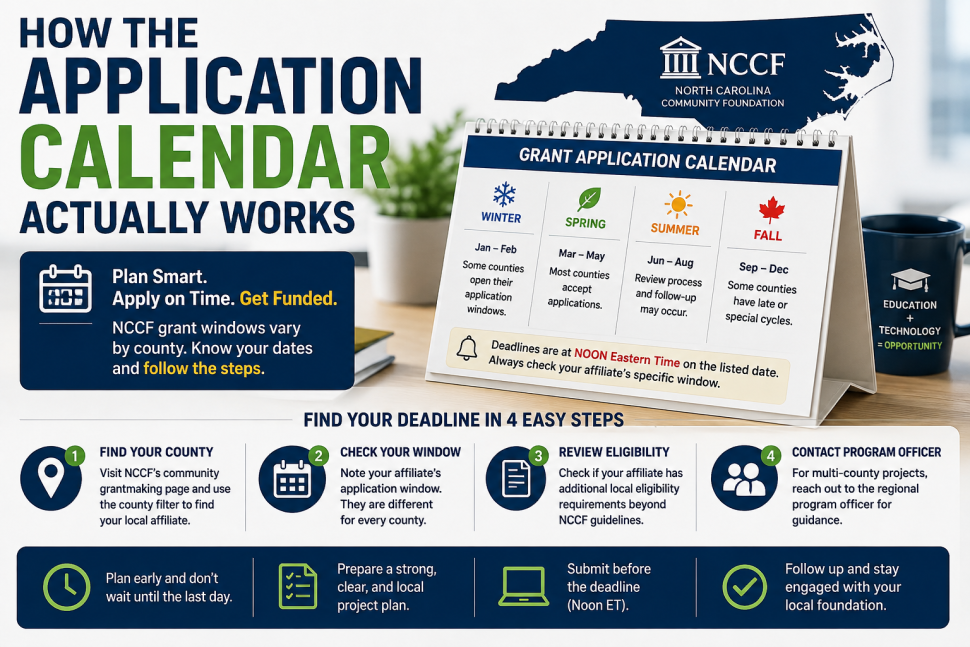
A lot of grant guides stay pretty vague on this part, so here’s the practical version. NCCF puts out an annual calendar of application windows for each affiliate. Cycles usually close at noon Eastern Time on their listed date. Windows are staggered through the year rather than all opening together. Your specific county’s deadline could land in late winter, spring, or later, depending entirely on your affiliate.
Finding your actual deadline comes down to a few concrete steps. Head to NCCF’s community grantmaking page and use the county filter to see which of the 53 affiliates covers your area. Note that specific affiliate’s window, not the statewide calendar as a whole. They genuinely don’t all run on the same schedule. Check whether your affiliate has any extra local eligibility rules on top of NCCF’s general guidelines, because some do. And if your project spans multiple counties, just reach out directly to the relevant regional program officer before you apply. Save yourself the guesswork.
Other Paths Worth Knowing About
NCCF is the biggest piece here, but it’s not the only one. Being thorough actually matters if you’re trying to fund a real project rather than just checking a box somewhere.
Organizations in the western part of the state have the Community Foundation of Western North Carolina, CFWNC. It’s a completely separate, independent community foundation running its own programs, deadlines, and process. Worth checking directly rather than assuming NCCF covers that region, since CFWNC operates entirely outside NCCF’s affiliate network.
There’s also the state-level Digital Learning Initiative, run by North Carolina’s Department of Public Instruction. It supports public school units implementing digital teaching and learning practices, including a multi-year Digital Learning Impact Grant covering planning through assessment. Not a community foundation program at all, this one’s a direct state grant. But it overlaps heavily with the same applicants, and is genuinely worth pursuing alongside local foundation funding rather than picking just one.
And there’s broadband and digital equity funding too, aimed at closing the connectivity gap for students and communities. It’s historically included sizable state-level rounds for nonprofits, higher ed, and regional organizations. Some federally funded digital equity programs have hit funding changes or gotten cancelled in recent cycles, honestly. Good reminder to double check any program’s current status before you build a whole proposal around it. Funding landscapes shift fast. What existed last year isn’t guaranteed to still exist this one.
Who’s Actually Eligible for This North Carolina Technology Education Grant
This is money for organizations, not individuals, full stop. In practice that usually means public school units and charter schools, 501(c)(3) nonprofits doing education or youth development work, regional partnerships between schools and community groups, and libraries, after-school programs, or community learning centers.
If you’re a student personally hunting for tech funding, wrong search. That’s a scholarship, not a community foundation grant. North Carolina runs plenty of well-documented scholarship programs for that, including some directly through NCCF’s own scholarship portal.
What Actually Makes a Technology Education Grant Proposal Get Funded
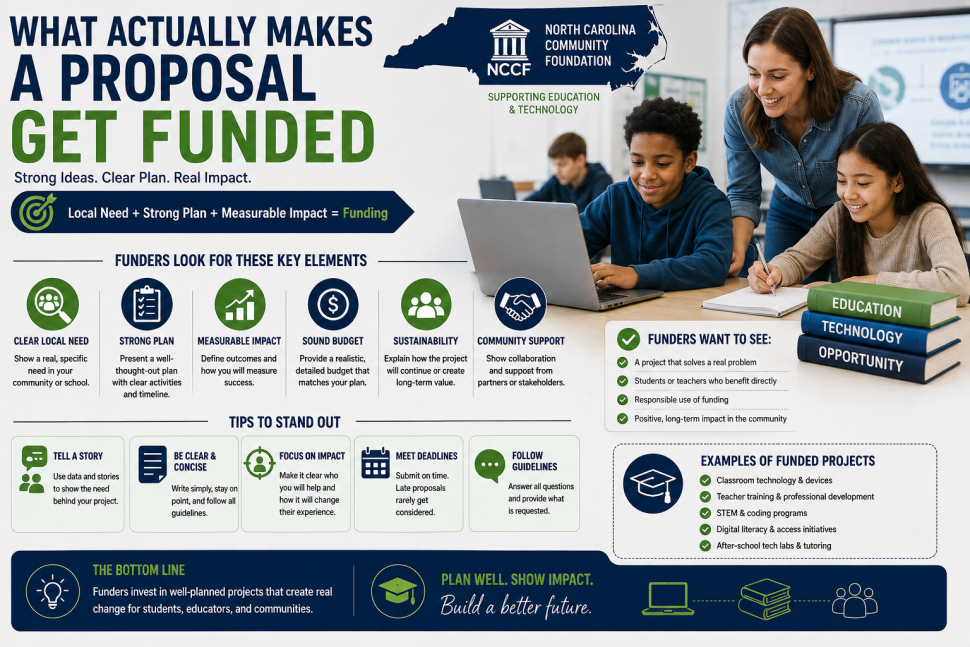
Most guides stop right at eligibility and deadlines. Since these local boards are made up of people who actually know their community, a handful of habits genuinely move the needle.
Name a specific, local problem, not a general one. “Our library’s public computers are eight years old and can’t run current testing software” beats “we need technology upgrades” every time. Attach a real number and show your math. Cost per device, students served, hours of tutoring covered, instead of asking for a round figure with nothing behind it. Show what happens without the money. Not to guilt anyone, just so the board understands the actual gap they’d be closing. Keep your ask scoped to what your affiliate typically funds. A quick look at past grantees on your affiliate’s page, where that’s available, tells you whether they’ve historically backed equipment, programming, staffing, or some mix. And submit early. Technical problems on your end at the last minute generally don’t get you an exception to a noon Eastern cutoff.
A Realistic Timeline
Right now’s the moment to figure out which of the 53 affiliates covers your county using NCCF’s filter. Give yourself four to six weeks before your window opens to draft a project description with real local detail instead of a generic pitch. Once the window’s actually open, submit well ahead of the deadline, don’t cut it close. After the cycle closes, expect a decision roughly two months out in most cases. And in parallel, check whether your project also fits NC DPI’s Digital Learning Initiative grants. Applying to both isn’t mutually exclusive. It just doubles your shot.
FAQs: North Carolina Technology Education Community Foundation Grant
Is there one statewide grant covering all this?
Not really, no. It comes through NCCF’s network of 53 local affiliates, each running its own cycle, deadlines, and priorities, rather than one single statewide application.
Who’s actually allowed to apply?
Organizations, mainly public school units, charter schools, and 501(c)(3) nonprofits. Not a path for individual students chasing personal funding.
How do you actually find your county’s deadline?
NCCF’s community grantmaking page has a county filter. It shows your relevant affiliate and its current application window.
Are these the same as the state’s Digital Learning Initiative grants?
No, different thing entirely. NCCF grants come through the community foundation network. Digital Learning Initiative grants come straight from the Department of Public Instruction. Both fund education technology work, and honestly applying to both is worth doing.
What if you miss your affiliate’s deadline?
Late applications, even ones caused by tech issues on your end, generally don’t get accepted. Get ahead of the cutoff, don’t test it.
Does this only cover public schools?
No, eligible nonprofits, libraries, and community organizations focused on education or youth development can apply too, depending on what your specific affiliate allows.
Is this grant only for 2026, or does it run every year?
NCCF’s affiliate grant cycles run annually, so this isn’t a one-time 2026 program. The specific deadlines and priorities can shift year to year though, so always confirm current details directly with your affiliate rather than assuming last year’s calendar still applies.
Where This Leaves You
A North Carolina technology education community foundation grant for 2026 was never going to be one program sitting behind one application link. It’s a network of 53 local foundations, each funding whatever its own community actually needs. That’s genuinely good news once you track down your specific affiliate. Smaller local applicant pools mean less competition than you’d face with a national program, and the people deciding actually understand your area firsthand. Start with the county filter on NCCF’s site, read your affiliate’s specific guidelines closely, and build your proposal around a real, local need instead of a generic tech pitch.