

Quick Answer
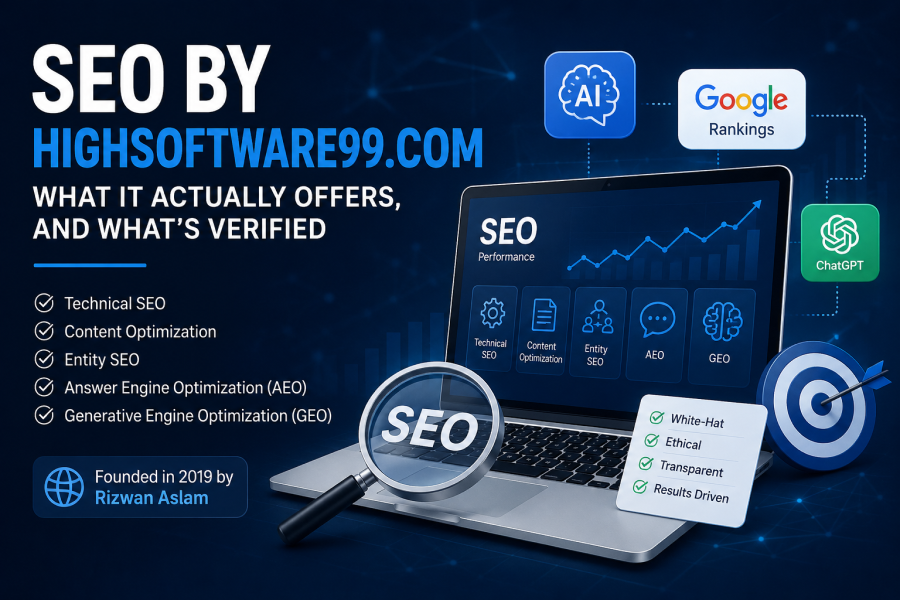
Here’s the short version, since it’s probably what brought you here. SEO by HighSoftware99.com is a branded SEO service, founded in 2019 by Rizwan Aslam, offering technical SEO, content optimization, entity SEO, Answer Engine Optimization (AEO), and Generative Engine Optimization (GEO). It’s not a Google product, algorithm, or officially endorsed framework, just one company’s package. Worth knowing too, client counts and case-study figures come from the company’s own materials, not independent verification.
Searched “SEO by HighSoftware99.com” and landed here trying to figure out whether it’s worth hiring, or just trying to make sense of the same name showing up across a handful of different sites? Either way, fair question, and I’m not going to recycle the vague claims you’ve probably already scrolled past three times today.
Quick answer: it’s a branded SEO service, founded back in 2019, offering technical SEO, content strategy, entity optimization, and the newer stuff, Answer Engine Optimization and Generative Engine Optimization. Not a Google product, not an algorithm, not some official framework with a blue checkmark. It’s one company’s service package, and like any vendor’s pitch, the numbers attached to it deserve the same scrutiny you’d give any agency before signing a contract.
What Is SEO by HighSoftware99.com?
Per the company’s own materials, Rizwan Aslam founded it in 2019, built around five layers, technical SEO, content optimization, entity SEO, AEO, GEO. The pitch: rank a site in classic Google results and inside AI-generated answers, ChatGPT, Gemini, Google AI Overviews, at the same time.
A quick reference before diving deeper: the service goes by SEO by HighSoftware99.com, founded by Rizwan Aslam back in 2019, built around five core offerings, technical SEO, content optimization, entity SEO, AEO, and GEO. Stated reach sits at 300+ websites across 40+ industries and five markets, the US, UK, India, Germany, and UAE.
Worth actually explaining what AEO and GEO mean, since they’re doing a lot of work in the pitch. AEO’s about structuring content so it directly answers a specific question, the format that gets pulled into featured snippets or read out by a voice assistant. GEO’s a bit newer, it’s about the signals large language models weigh when deciding what to cite in a generated answer: factual accuracy, clearly defined entities, sourcing that looks authoritative, structure that makes the key facts easy to pull out. Neither one’s a separate algorithm or some clever trick. Both just describe optimizing for qualities Google’s been documenting for years, useful, well-structured, trustworthy content, dressed up in newer terminology.
The company claims 300+ websites, 40+ industries, five markets (US, UK, India, Germany, UAE). Self-reported numbers, all of it, not something a third party’s independently verified. Doesn’t automatically make it false. Just means treating it the way you’d treat any agency’s case study page, useful context, not proof on its own.
Is SEO by HighSoftware99.com Legit? Claims vs. What Checks Out
A lot of the content under this name repeats the same phrases: white-hat, ethical, no shortcuts, full transparency. Standard stuff in this industry, honestly, and worth checking against something more solid than the copy itself.
What holds up fine: the described methodology, audits, keyword and entity research, on-page work, link building, matches what Google’s own documentation says actually matters. Nothing here contradicts how ranking factors are supposed to work. And the AEO/GEO emphasis tracks with something genuinely happening right now, a real chunk of searches surface an AI-generated answer before anyone clicks through to an actual website.
What’s harder to pin down: “instant” results, “90 days” promises, that kind of specific outcome claim. Ranking timelines depend heavily on where a site’s starting from, competition, technical health, not purely on whichever service gets applied. Client counts, founding story, industry spread, all self-reported, not independently audited anywhere I could find. Not unusual for a service business. Still worth knowing the difference between a company describing itself and a claim someone else confirmed.
Can SEO by HighSoftware99.com Really Get Instant Rankings?
This one earns its own section, it’s the claim attached most often to this keyword, and the one most likely to mislead somebody. Real SEO, whoever’s providing it, runs on a timeline shaped by how search engines actually crawl, index, and build trust signals over time. A technical fix can land in days, sure. Content authority and backlink trust? Those take months, pretty much no matter who’s doing the work. Any service promising truly instant top rankings for a competitive term is describing something that doesn’t match how modern search actually functions, regardless of which specific company’s making that claim.
Breaking Down the Five Layers, One at a Time
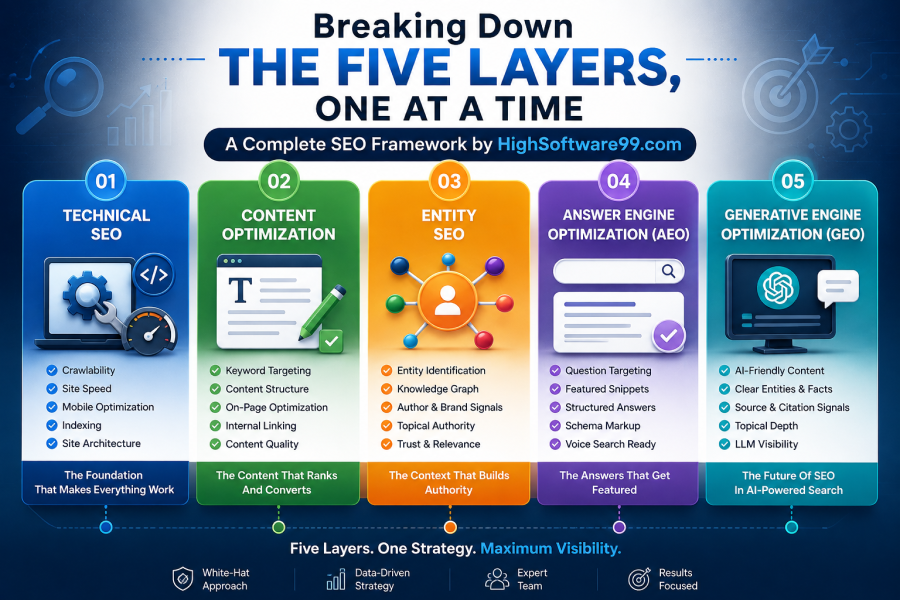
Five distinct pieces, working together, that’s the whole pitch. Worth actually understanding what each one does rather than nodding along at “five-layer system” as just another marketing phrase.
Technical SEO’s the plumbing nobody sees, crawlability, site speed, mobile responsiveness, structured data, broken links, duplicate content, HTTPS. Nothing exclusive about any of it, it’s foundational stuff straight out of Google’s own Search Central documentation. Any competent service runs this audit first, not as an afterthought.
Content optimization’s what most people picture when they hear “SEO.” It means matching what a page says to what someone’s genuinely searching for. Real intent research, not stuffing a keyword into a paragraph a dozen times. Write for the actual question being asked. Both classic search and AI-generated answers reward content that resolves a query cleanly, not content that pads around it forever.
Entity SEO goes a step past keywords. Not just targeting a phrase, but clearly establishing who or what a page’s actually about, a business, a person, a product, a concept. That entity then connects to related ideas, the way Google’s Knowledge Graph handles things internally. Clear entity signals stop search engines and AI systems from guessing. That matters more now, since a real chunk of results come from systems interpreting meaning rather than matching text strings.
AEO, again: structure content so a direct question gets a direct, extractable answer near the top of the page, not buried three paragraphs down. That format’s what tends to win featured snippets and voice search results specifically.
GEO’s the newest of the five, and honestly the one deserving the most scrutiny, since it’s still genuinely evolving. Core idea holds up fine though: AI systems generating answers favor sources with clear factual claims, defined entities, structure that makes info easy to lift cleanly. But GEO doesn’t have the years of documented case studies traditional SEO has built up. Any provider claiming a fully proven GEO formula is describing something the whole industry’s still figuring out in real time, not a solved problem.
How This Compares to a Typical SEO Engagement
Context helps here. “Five-layer system” sounds unusual until you realize most competent agencies already do some version of all five, they just don’t package it under named layers like this. A traditional retainer usually covers a technical audit, keyword research, on-page work, link building, basically layers one, two, and part of four above. What’s genuinely newer is framing AEO and GEO as separate, explicit deliverables, which reflects a real industry shift rather than something exclusive to one provider. Plenty of competing agencies have rolled out similar AI-search packages over the past couple years. Not an exclusive methodology, just a response to where traffic’s actually heading.
What a Reasonable Engagement Actually Looks Like
Pricing and process details aren’t fully public for this specific service. Here’s what a legitimate engagement generally looks like industry-wide instead, useful for comparing any quote against. Usually opens with an audit phase, technical issues, content gaps, competitor analysis, one to two weeks before real work starts. From there, a realistic roadmap with actual priorities, not everything fixed at once. A credible provider explains why certain fixes come first. Reporting should tie back to business outcomes, not vanity metrics, since tracking keyword rank means little if none of it translates to actual traffic. Timelines matter too: meaningful movement on competitive terms takes three to six months minimum, sometimes longer, regardless of provider. Worth remembering against any promise of quick results.
Red Flags Worth Watching For With Any SEO Provider
Applies broadly here, not just to this one company, but directly relevant to anyone evaluating a purchase decision on this keyword. No legitimate provider controls Google’s algorithm closely enough to promise a specific spot, so be cautious of guaranteed rankings for competitive terms. Vague reporting, keyword movement with no tie back to actual traffic, is another one worth watching for. Anyone unwilling to explain methodology in plain language raises a flag too, since obscured tactics sometimes mean outdated or risky practices rather than genuine expertise. And check whether case studies name real, verifiable client sites, not anonymous “300% growth” claims nobody can confirm.
Why Isn’t My Site Ranking, and What Actually Helps?
A good chunk of people searching this term are actually trying to fix a ranking problem of their own, so let me be direct here. No single article, service, or tool fixes a ranking issue without knowing what’s actually causing it first.
Start with Search Console, check for manual actions, crawl errors, indexing problems, before assuming it’s a content issue. Make sure whatever page targets your keyword actually answers the query clearly in its first few sentences, both for human readers and for AI systems scanning for something extractable. Double-check the basics too, site speed, mobile usability, HTTPS, still baseline ranking factors no matter how advanced the content strategy gets layered on top. And build around real expertise and clear sourcing rather than keyword density alone, that’s genuinely what both classic SEO and the newer AEO and GEO signals reward in the end.
A quick self-check worth running before hiring anyone: pull up your top three pages in Search Console and look at click-through rate versus impressions. A page getting impressions but few clicks usually has a title or meta description problem, not a ranking problem. A page with neither impressions nor clicks likely has an indexing or content-relevance issue that needs fixing before any outside service, this one or another, can meaningfully help.
Frequently Asked Questions
What is SEO by HighSoftware99.com?
A branded SEO service built around technical SEO, content strategy, entity optimization, AEO, and GEO. Founded in 2019, per the company’s own materials.
Is it endorsed by Google?
No. Private company, private service. Not a Google product, algorithm, or officially endorsed anything.
Can it actually get instant rankings?
Treat that claim carefully. Ranking timelines depend on a site’s technical health, competition, and trust signals built over time, not on any one service alone, however good it is.
What’s actually different between SEO, AEO, and GEO?
SEO covers the traditional ranking factors. AEO structures content to directly answer specific queries, snippets, voice search, that kind of thing. GEO focuses on what AI systems weigh when deciding what to cite in a generated answer. All three, underneath it, reward the same basic stuff, clarity, accuracy, genuine usefulness.
Are the client numbers verified by anyone outside the company?
Not that’s publicly documented, no. Client count, industries served, all self-reported. Worth treating as context, not proof.
How long should a real SEO campaign take to show results?
For most competitive keywords, three to six months minimum before meaningful movement, sometimes longer for highly competitive industries. Technical fixes can show impact faster, but authority and trust signals take time to build regardless of provider.
Should I hire an SEO service or handle it myself?
Depends on time, technical skill, and site complexity. Smaller sites with basic technical health can often improve significantly through in-house effort using free tools like Search Console. Larger or more competitive sites usually benefit from outside expertise, particularly for technical audits and entity-level strategy that take specialized experience to execute well.
Bottom Line
SEO by HighSoftware99.com describes a real, structured service built on standard technical and content practices, with a genuine nod toward the AEO and GEO shift that’s actually happening in search right now. The core methodology checks out against how search engines are documented to work. The specific numbers and outcome claims, though, come straight from the company itself, and deserve the same due diligence you’d give any vendor. Ask for references. Check independent reviews. Confirm your own site’s technical fundamentals before assuming any single service fixes a ranking problem on its own.