

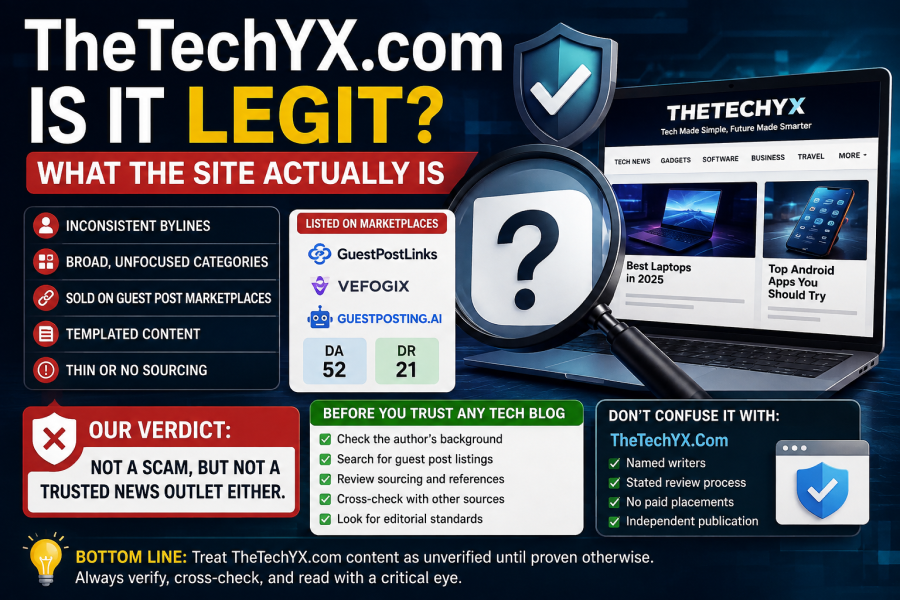
Type “thetechyx.com” into Google and something odd shows up almost immediately. Nearly every article claiming to explain the site turns out to be the same kind of site itself. No byline worth checking. Published within days of a handful of near-identical write-ups scattered across other domains. Not really a coincidence, that. It’s basically become the answer to its own question, if that makes sense.
So instead of adding one more of those, here’s what’s actually going on. What TheTechYX.com publishes. Why it keeps turning up as a guest-post listing everywhere. How not to confuse it with a similarly named site (easy to do, more on that below). And a short checklist you can use on pretty much any tech blog before trusting a word it says.
Quick Answer: Is TheTechYX.com Legit?
Short version – it’s a multi-topic content site covering tech news, tools, business, and a couple of categories that honestly don’t have much to do with tech. All under the tagline “Tech Made Simple, Future Made Smarter.” Scam? No, not in the sense of stealing money or data. A staffed editorial publication, in any normal sense of the term? Also no. Authors don’t show up consistently from one article to the next. And at least four separate guest-post marketplaces actively sell placements on the domain, sometimes for under $20 a post – which honestly says a lot on its own. Best approach: treat anything published there as unverified until you’ve got a reason to think otherwise, not the other way around.
What TheTechYX.com Actually Publishes
The homepage covers a lot of ground. Tech news, gadget roundups, software tips. Then, oddly, categories like business and travel that don’t really belong on something calling itself a tech site. That kind of scattershot breadth usually signals a site built mainly to host other people’s content, rather than a small team producing its own reporting on a beat.
The articles themselves read as generic. Safe, broad, written to rank for a keyword rather than to actually say something. Bylines are all over the place too. Some pages carry a generic staff name, others carry nothing at all. Go looking to verify who wrote a specific piece, or what their background is, and you’ll come up empty more often than not.
Why TheTechYX.com Shows Up on Guest-Post Marketplaces
This is the part most “about this site” write-ups conveniently skip. Multiple SEO marketplaces list TheTechYX.com for sale as a guest-post placement – GuestPostLinks, Vefogix, and GuestPosting.ai among them, from what I found while checking. These marketplaces put its Moz Domain Authority somewhere in the low 50s and its Ahrefs Domain Rating around 21. That’s the kind of number marketers use to estimate how much link value a placement might carry over.
None of that is illegal, to be fair. Paid guest posting is a pretty normal, if controversial, corner of the SEO world. Google’s own guidance on link spam treats paid links used to manipulate rankings as a spam-policy violation, whether or not the publishing site discloses the arrangement. What actually matters to a reader is simpler than any of that, though: a site that’ll sell a placement to whoever hands over $20 has little reason to fact-check what goes up. The buyer picks the topic and the angle. Not an editor.
The Confusable Name Problem
Searching this name also gets messy fast, because a separately branded site – TheTechYX.Com, capitalized differently – positions itself as basically the opposite. It names its writers, publishes a stated review methodology, and openly rejects both “generated slop” and paid placements outright. These are two different operations. Not the same thing wearing a different hat. Confusing them leads to the wrong conclusion no matter which direction you mix it up. So before citing anything under the “TheTechYX” name, it’s worth double-checking exactly which domain and which byline the claim actually traces back to.
Red Flags Common to Guest-Post-Driven Sites

A handful of signals tend to separate a site like this from something genuinely staffed:
- No consistent bylines. Real publications name their writers and let readers check their track record over time. A site that rotates anonymous or generic author names usually isn’t running much of an editorial process behind the scenes – there’s often no one to run it.
- Broad, unfocused categories. Tech, business, travel, and sports crammed onto one domain is a pretty typical pattern for link-building real estate, not for a specialized outlet with an actual beat.
- Active marketplace listings. If a domain shows up for sale on guest-post platforms at a fixed price per post, assume the article you’re reading came from a buyer, not an editor’s assignment.
- Templated “about” coverage. When most search results explaining a site are themselves generic, unsigned guide articles, that usually means the same content pattern keeps circling back and forth between similar domains – this article included, arguably, if it weren’t trying hard not to be.
- Thin sourcing. Claims with no link to anything specific, or identical phrasing across supposedly independent write-ups, point toward content made for search visibility rather than accuracy.
Should You Trust an Article Published There?
Depends entirely on what’s actually being claimed, honestly. A basic explainer on some common tech topic, pulled together from information that’s already widely available, carries pretty low risk either way. Nobody’s getting hurt if a “how to clear your cache” guide happens to be a little generic. A specific factual claim, a product recommendation, or anything touching health, finance, or security is a different situation entirely. That deserves a second source before anyone actually acts on it. True of any site without visible editorial standards, not just this one in particular.
Anyone citing TheTechYX.com in their own work might want to check the FTC’s guidance on native advertising and disclosures too. The FTC has already addressed this gray area pretty directly, for advertisers and publishers alike: paid placements that read like editorial content need to disclose that they’re paid.
How to Verify Any Tech Blog Before Trusting It
Same checklist applies whether the site in question is TheTechYX.com or some domain nobody’s bothered writing about yet:
- Look for a named author with an actual, checkable history – not just a generic “staff” credit slapped on top.
- Search the domain name next to “guest post” or “backlink” and see if it’s being actively sold as placement real estate somewhere.
- Pull up two or three articles on the same topic from different corners of the site. Templated writing tends to repeat the same structure and phrasing once you actually start comparing them side by side.
- Check whether the factual or statistical claims link to a primary source anywhere, or just sit there unsupported.
- Cross-reference anything specific or actionable against a second, independently reported source before leaning on it for anything that matters.
Bottom Line on TheTechYX.com
TheTechYX.com is a broad-topic content site. Multiple SEO marketplaces actively sell guest-post inventory on it, its bylines don’t quite add up, and there isn’t much visible editorial process behind what actually gets published. Doesn’t make it dangerous. It just means anything read there deserves the same scrutiny you’d give any other unverified source – check the author, check the sourcing, and don’t mix it up with the similarly named site that markets itself as the exact opposite kind of publication.
Frequently Asked Questions
Is TheTechYX.com a scam?
Not really, no evidence points to it stealing money or personal data. It’s more of a content-and-guest-post operation than a staffed news outlet, so it’s a credibility issue more than a security one.
Who owns or writes for TheTechYX.com? Bylines are inconsistent, and no public source documents a clear editorial team or ownership info. Fairly common trait, this, among sites built mainly for guest-post and link placements.
Is TheTechYX.com the same as TheTechYX.Com with capital letters?
Nope – a separately operated site with similar branding, but it markets itself as an independent publication with named writers and a stated review process. Two different sources, don’t treat them as one.
Can I buy a guest post on TheTechYX.com?
Yes, pretty easily, actually. Several third-party SEO marketplaces list paid placements on the domain starting under $20 a post. Worth knowing before treating any article there as independently reported.
Is it safe to cite TheTechYX.com as a source?
For general, low-stakes information, sure. Anything specific, statistical, or actionable should get checked against a second source with visible editorial standards first – no shortcuts there.
Botton line:
Our Legitimacy Checker is built exactly for verifying an unfamiliar site before you trust or cite it. Our Technology section has more breakdowns like this one, for tech sites and tools worth a second look before anyone relies on them.